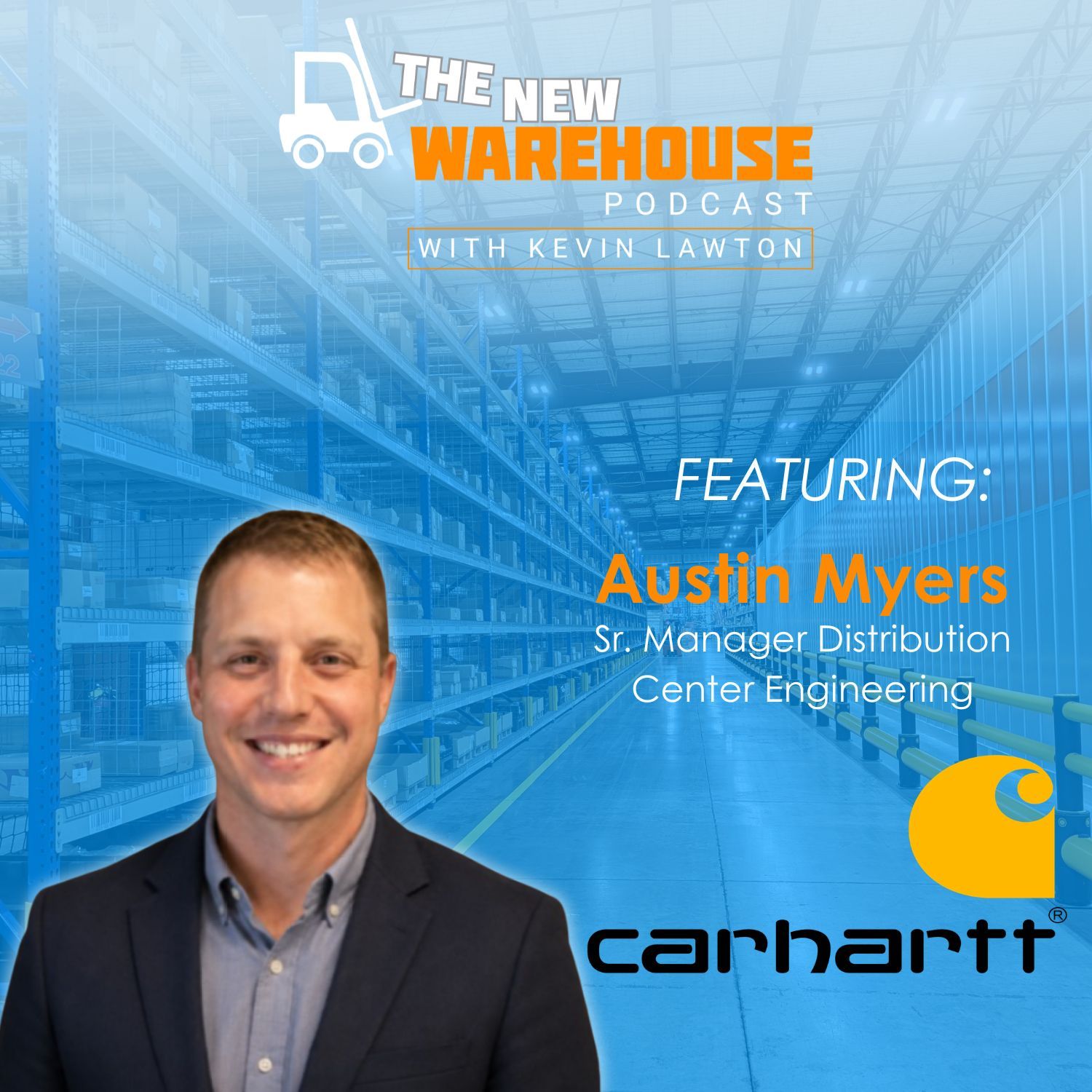
Warehouse Flexibility: Inside Carhartt’s Automation Strategy
As a long-time owner of a Carhartt Duck Detroit Jacket, I was especially interested in how its distribution centers operate. Today’s episode of The New Warehouse welcomes Austin Myers. Myers is the senior manager of distribution center engineering at Carhartt.
The family-owned company now operates five distribution centers spanning Carhartt-managed and DHL-operated facilities. Tune in for a practical look at how Carhartt is building a warehouse network designed to handle both long-term growth and unexpected change.
Building the Network and Using the 3PL Relationship
Carhartt’s network includes a 180,000-square-foot recommerce center where returns are processed with corrugate bins and push carts. The goal is speed, not complexity. “Instead of sending it all the way back to the distribution center, we’re able to get it back into stock within an hour or two and get it to the customer quickly, versus taking a day or two or a week to get it back into stock.”
DHL gives Carhartt another layer of warehouse flexibility. Its engineering resources and broader network create a proving ground for new technology. “A lot of times they’ll do a proof of concept, or they’ll run it in one of our buildings. We’ll vet it out before we roll it out to the others,” Myers says. It becomes a source of testing, engineering knowledge, and network intelligence. “A lot of the technology, like Locus Robotics and Boston Dynamics, just made so much sense that it was hard to argue.”
Choosing Automation Without Getting Trapped by It
Carhartt takes a deliberate approach to automation. Before seriously considering Exotec, the team visited several installations, attended demos, and spoke with existing users. “We went to two different trade shows and demos and talked to probably seven different customers that had worked with Exotec before we really even brought that to the table as a solution.”
The company also looks beyond equipment cost. Its previous crane-based ASRS had become obsolete, creating a significant single point of failure. The replacement offered more capacity, which changed the economics. “Capacity means we don’t have to open another building,” Myers says.
Carhartt is also moving toward less proprietary technology. “If it’s a proprietary solution, you really can’t see under the hood on what’s going on in your facility.” That matters because internal controls engineers can make changes without waiting for outside specialists.
Change Management, Demand Volatility and the Future of Automation
Technology decisions still affect people. Carhartt’s Kentucky operation is unionized, making communication especially important during automation projects. “The biggest thing is just full transparency on what you’re doing, when you’re doing it, when it’s coming, and how it’s going to impact them.”
Demand can change just as quickly. When Carhartt’s beanies surged in popularity, the company and DHL created a 150,000-square-foot pop-up facility devoted to millions of beanies. Myers says the challenge is knowing whether a spike deserves permanent capacity. “Let’s not build the church for Easter Sunday. Let’s figure out if this is going to be an ongoing thing or not.”
That experience shapes what Myers wants from future automation. Modular systems can scale without requiring another building or massive infrastructure project. “We can add bots, we can add more capacity pretty easily. You don’t have to stand up a lot of infrastructure to do that.”
For Carhartt, warehouse flexibility is becoming a defining requirement for warehouse technology.
Key Takeaways on Warehouse Flexibility
- Strong 3PL relationships can provide engineering expertise, technology testing, and warehouse flexibility.
- Carhartt’s recommerce center can process returns within an hour.
- Automation ROI should include capacity, downtime, maintenance, staffing, and avoided facility expansion.
- Proprietary systems can create operational dependence long after implementation.
- Transparency is essential when automation changes how employees work.
Listen to the episode below and leave your thoughts in the comments.
Guest Information
For more information on Carhartt, click here.
To connect with Austin Myers on LinkedIn, click here.
For more information about automation strategy and warehouse flexibility, check out the podcasts below.
Warehouse Automation Strategy Starts with Software
Interact Analysis: Inside the 2026 Warehouse Automation Market