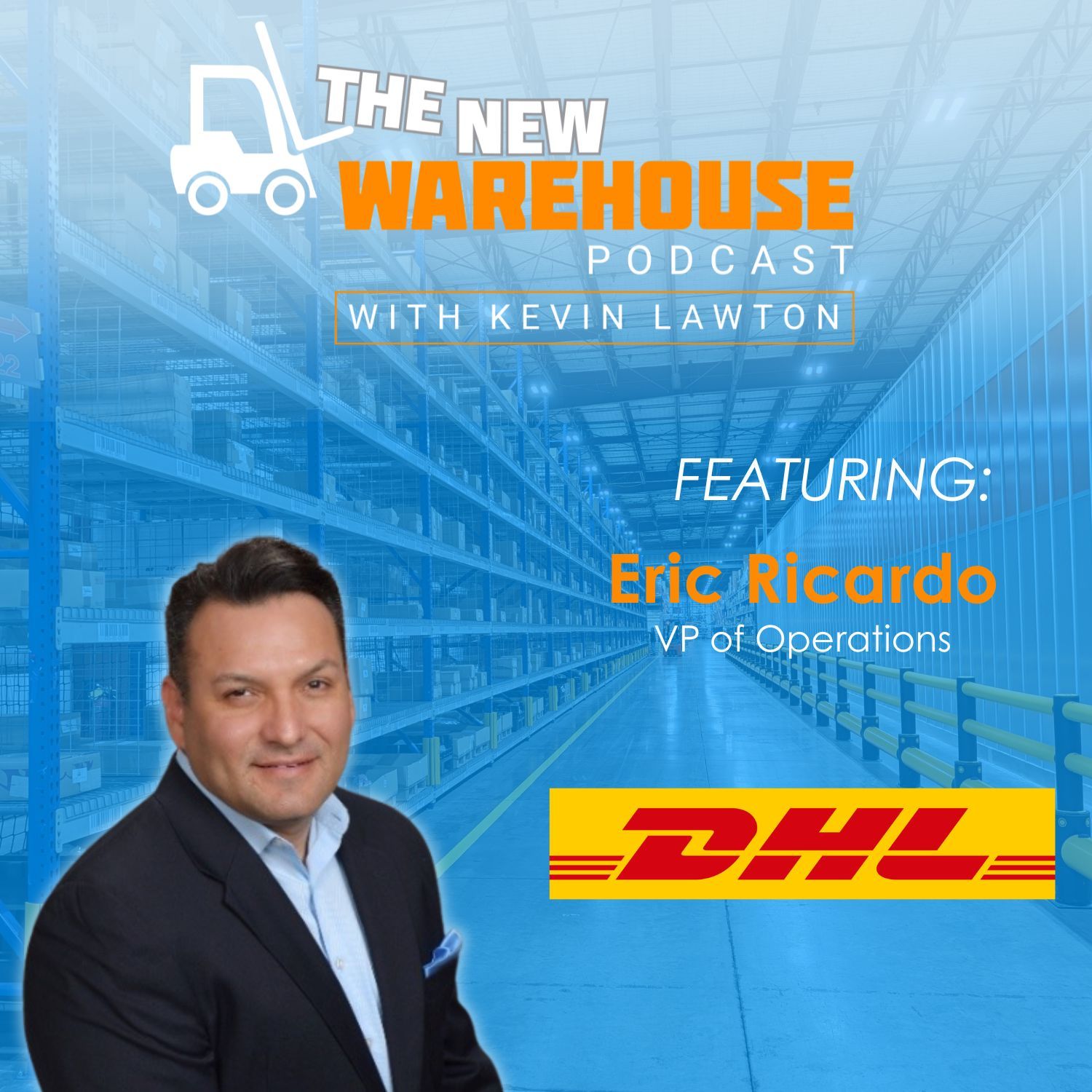
Parcel Shipping Operations: Moving Packages in Minutes with DHL
In this episode of The New Warehouse Podcast, Kevin chats with Eric Ricardo, VP of Operations at DHL eCommerce. Eric breaks down how DHL eCommerce operates within the broader DHL network and how it connects retailers to end consumers.
The conversation centers on parcel throughput optimization, network design, and the balance between automation and labor. Eric shares how DHL moves millions of packages daily, manages peak demand fluctuations, and plans years in advance to maintain speed and consistency. More importantly, he explains how throughput defines success in modern parcel shipping operations.
Designing Facilities for Speed and Throughput
DHL eCommerce is built around one core idea: move packages as fast as possible. Unlike traditional warehouse models, storage is not the goal. Instead, every design element maximizes flow through the building.
Eric highlights the scale of parcel shipping operations, noting “we move millions of packages per day.” That volume requires facilities engineered for speed. Some sites can handle extreme throughput, with Eric explaining, “Our largest facility can process up to 70,000 packages an hour.” These aren’t static environments but instead systems designed to handle fluctuating demand, especially early in the week when volume spikes.
This focus drives how facilities are built and measured. Eric emphasizes that success comes down to “Throughput per square foot.” That metric forces teams to maximize output from every inch of space. Instead of large storage footprints, DHL prioritizes compact, high-velocity sortation environments.
Why Throughput Is Measured in Minutes, Not Days
Parcel shipping operations function on a completely different time scale than traditional warehousing. DHL doesn’t think in days or weeks. It thinks in minutes.
Eric explains the difference clearly: “We want to get it in, we want to get it out as quickly as possible. We don’t store things.” That mindset shifts everything from layout to labor strategy. Instead of inventory dwell time, DHL measures performance in near real-time flow.
The goal is aggressive. Eric shares, “The challenge that I’ve given our industrial engineers… is to have nothing sitting in a facility for more than an hour.” That target pushes continuous improvement across automation, staffing, and process design.
To make that possible, parcel shipping operations must feel fast, almost chaotic. But there’s structure behind what others would perceive as chaos. As Eric describes it, “it’s an orchestrated symphony with all these.” Every system, person, and process must stay aligned to maintain that flow.
Balancing Automation, Labor, and Future Growth
Automation plays a major role, but it is not the entire story. DHL approaches technology with a practical mindset, focusing on ROI and scalability rather than chasing trends.
Eric points to new models like flexible deployment, saying “robot as a service has popped up and made a difference over the last five or six or seven years.” This allows DHL to test solutions without heavy upfront investment. It also creates room to adapt as technology evolves.
Still, people remain critical. Eric makes it clear that automation does not eliminate the workforce. Instead, roles evolve. As he puts it, “you’re only gonna be as good as the people that are bolting on and working with that automation.” Even as systems improve, human oversight, planning, and maintenance remain essential.
Looking ahead, DHL continues to invest in both technology and talent. With long-term projects and ongoing pilots, the company is positioning itself to scale alongside e-commerce growth while maintaining reliability and consistency.
Key Takeaways on Parcel Shipping Operations
- DHL eCommerce moves millions of packages daily across a network of nearly two dozen U.S. facilities
- Peak volume can double early in the week compared to later days
- Largest facilities can process up to 70,000 packages per hour
- Throughput per square foot is a primary KPI for facility performance
- Parcel dwell time is measured in minutes, not days or weeks
- The target goal is under one hour of dwell time per package in a facility
- DHL invested roughly $300 million in network upgrades over a multi-year period
- DHL designs facilities to scale and adapt to future automation
- Robot-as-a-service models enable flexible testing of new technologies
- Labor remains essential, with roles shifting toward higher-skill functions
- Reliability and consistency are key differentiators for customers
- Customer expectations are shifting toward balancing speed and cost
Listen to the episode below and leave your thoughts in the comments.
Guest Information
For more information on DHL eCommerce, click here.
To connect with Eric Ricardo on LinkedIn, click here.
For more information about parcel shipping operations, check out the podcasts below.
Right-Sized Packaging: A Box Last Approach Means Lower Costs & Less Waste