Unit AI: They Don’t Sell Robots, They Sell Capacity
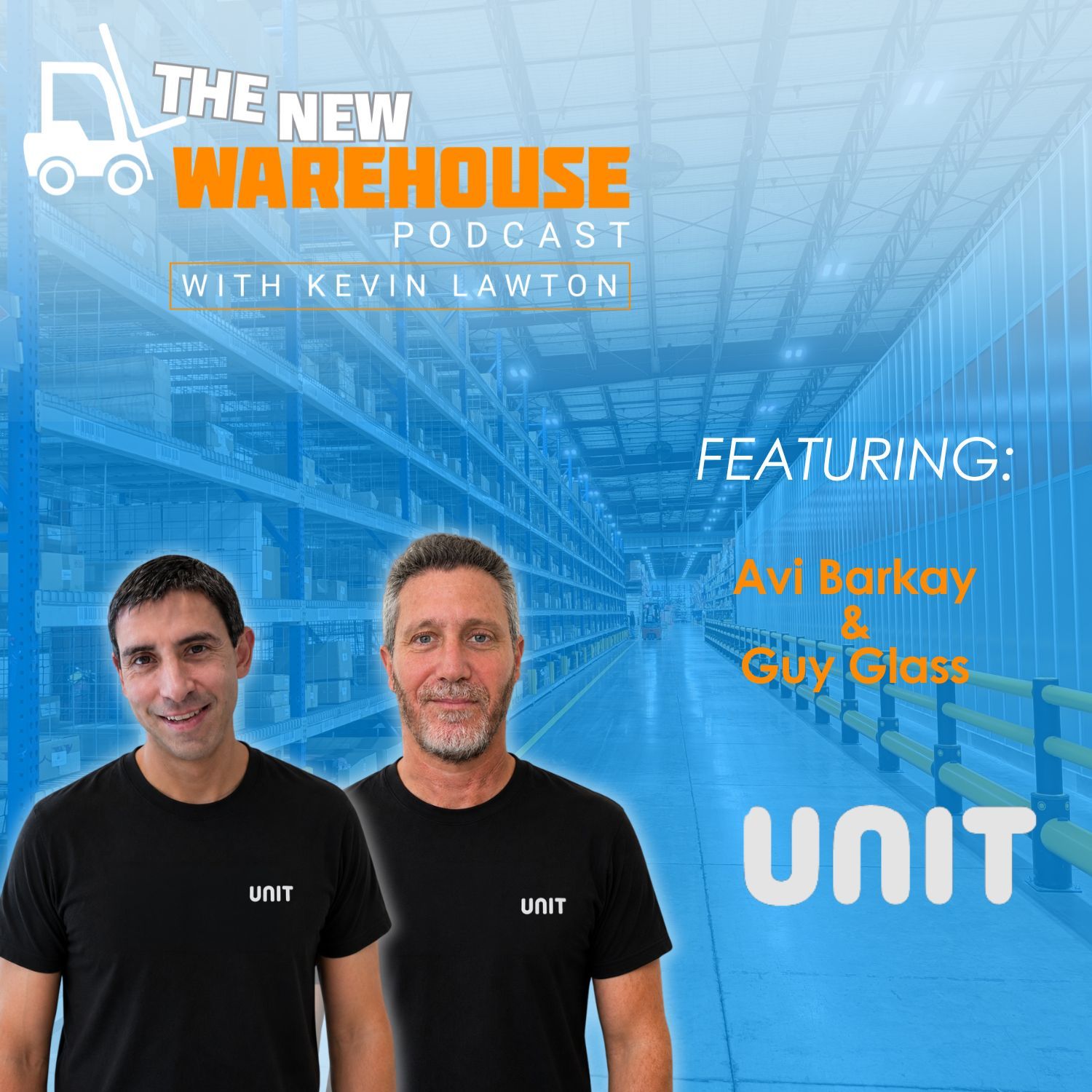
Welcome to this episode of The New Warehouse Podcast, where host Kevin Lawton sits down with Avihou Barkay, Co-Founder and Chief Business Officer, and Guy Glass, Co-Founder and CEO at Unit AI. Unit AI is a new entrant into the automation market, introducing a plug-and-play micro AS/RS platform designed to solve the $1 trillion e-commerce crisis.
In this episode, Barkay and Glass discuss how their purpose-built physical AI system makes automation dramatically more accessible, affordable, and flexible for 3PLs and retailers navigating high return volumes and direct-to-consumer logistics.
E-Commerce Exposes a Supply Chain Design Gap
Modern e-commerce asks supply chains to perform work they were never designed to handle. Barkay explains, “Supply chain was built to move things in bulk, right? Wholesale, retail fulfillment, it’s all about moving things in bulk.” Today, more than 40 billion items cross the United States toward consumers, according to Barkay. About 9 billion items then move back through returns networks.
E-commerce volume creates costly item-level handling across systems built for pallets, cases, and bulk replenishment. Barkay says the industry has “got to a point where we’re moving literally billions of items to our doorstep.” Returns deepen the problem. He notes that one in five items is returned on average. Some brands experience return rates between 50% and 70%. Yet, as he points out, “ Even among large enterprise-grade companies, only twenty-five percent of their warehouses are actually automated, which is nuts, right?”
Automation Must Deliver on the Three R’s
Automation adoption depends on more than technical capability. Barkay says, “For any automation to be successful, it’s gotta hit what we call the three Rs, right? The rate, the reliability, the ROI.” However, Barkay believes penetration is so low in warehousing because one of those Rs is typically missing.
Unit AI approached the problem through system-level design. Barkay recalls the guidance, “Instead of just thinking about the robots, think about the box. Make the box smart. You can drastically reduce the complexity and the cost of the robots and make them more robust.” Glass applies the same simplification principle to software. He says, “Nothing complicated, in order to start to work on the system. And later on, you can add more and more capabilities, do a deeper integration.”
Unit AI combines standard shelving with smart floor tiles and a fleet of robots smaller than a Roomba. The tiles support navigation, charging, and item weighing, allowing the robots to remain relatively simple. Deployments take just one week and eliminate expensive floor prep.
Unit AI Delivers Capacity-Based Automation
Traditional automation purchases often require companies to estimate future demand and buy enough equipment to support it. Unit AI takes a different approach by selling throughput rather than individual machines. Barkay explains, “Our contracts don’t even mention the word robot. You can do a Ctrl+F; you will not find the word robot anywhere in that agreement. We sell you capacity.” Customers determine the throughput they need, while Unit AI assumes responsibility for meeting that service level.
The small robot design supports that flexibility. Inside the structure, Barkay says Unit AI uses “a fleet of a few dozen robots the size, you know, smaller than a Roomba, that move these totes.” If volume increases, additional robots can be added without renegotiating a major equipment purchase. Barkay explains, “All we have to do is ship you another five, ten robots.”
Key Takeaways from Unit AI
- The Three Rs Rule: Successful automation requires hitting rate, reliability, and clear ROI—where most legacy systems fall short.
- Ultra-Fast Deployment: Unit AI installs in a single week starting at 1,000 square feet, reducing setup costs to around $200,000.
- Capacity Business Model: Customers pay 14 cents per presentation without purchasing or managing physical robots directly.
- Zero On-Site Technicians: Small, swarm-style robots are hot-swappable via regular shipping boxes if repairs are needed.
- Decentralized Logistics: Lowers barriers so fast-moving items and returns can be handled locally instead of transcontinental transit.
Listen to the episode below and leave your thoughts in the comments.
Guest Information
For more information on Unit AI, click here.
To connect with Avihou Barkay on LinkedIn, click here.
To connect with Guy Glass on LinkedIn, click here.
For more information about solutions like Unit AI, check out the podcasts below.
Flexible Warehouse Automation and the Future of Fulfillment
How Relay Distribution Scaled with ASRS Automation and Social Strategy
MHI Industry Group Series: Automated Storage and Retrieval Systems (ASRS)

Before Adding a Warehouse, Maximize the One You Have » The New Warehouse
[…] Unit AI: They Don’t Sell Robots, They Sell Capacity […]