The New Warehouse Amazon List: 7 Rules for Smarter Warehouse Automation
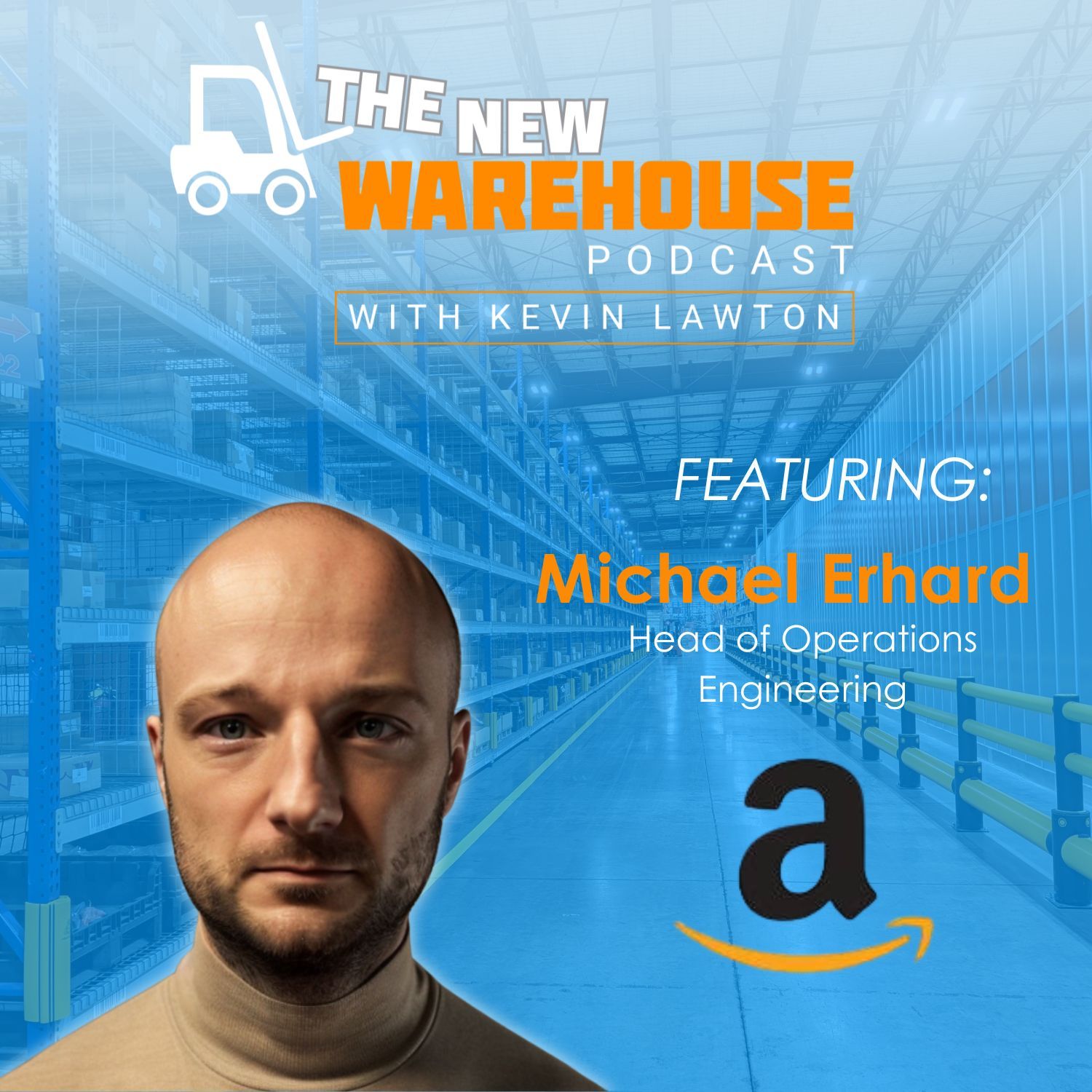
On this episode of The New Warehouse Podcast, Kevin speaks with Michael Erhard, Head of Operations Engineering at Amazon. During a career spanning more than 15 years, Erhard has helped plan, design, and launch fulfillment centers around the world, including more than 50 facilities during his time at Amazon. His lessons challenge technology-first thinking and reveal what it really takes to design, test, launch, and modernize highly automated fulfillment operations.
Below you’ll find The New Warehouse Amazon List, not a collection of products to purchase, but seven principles to consider before making your warehouse automation investment.
1. Warehouse Automation Should Be the Output, Not the Starting Point
The most important message is that companies should not begin with a technology they saw at a trade show or in another facility. They should begin with the customer promise, expected demand, labor market, available real estate, project timeline, inventory profile, and required throughput.
“I’ve seen so many small and big companies wasting millions on technology and hardware that is actually not helping the customer to be happier, to get the right product at the right time and the right quality.”
The technology should emerge from those conditions. Erhard’s warning about companies wasting millions gives this argument urgency rather than making it sound like generic design advice.
2. Automation Does Not Eliminate Operational Complexity
A highly automated building is not one system. It is a collection of conveyors, sorters, lifts, robotics, controls, sensors, software, storage systems, and human workflows that must operate together.
“The more automated the solution is, the more complex it gets because you have multiple interfaces between different technologies.”
Erhard’s discussion of throughput qualification is especially important. Individual components can pass their own tests while the combined inbound or outbound process still fails under real operating pressure.
3. Warehouse Automation Projects Need Standards That Can Bend
Amazon’s ability to deploy facilities at scale depends heavily on repeatable templates, standardized vendors, milestones, KPIs, and execution playbooks. However, Erhard repeatedly emphasizes that buildings, real estate, disruptions, supply chains, and construction conditions rarely follow the ideal plan.
“I always tell my team this is like a skeleton to follow, but it’s made to deviate because a lot can go wrong, and every project writes its own story at some point in time. There’s always something waiting behind the corner that will ruin everything.”
The real lesson is not simply to standardize. It is to standardize enough to create control while preserving enough flexibility to adapt when the original plan becomes obsolete.
4. Brownfield Automation May Be Harder Than Greenfield Automation
A greenfield project has tremendous complexity, but teams can test equipment in a protected environment before operations enter. A brownfield project requires construction and integration work around a live operation that cannot stop shipping.
“I always describe this as an open-heart surgery. My wife, she’s a doctor, doesn’t see it like that, but I think for us as logistics experts, it’s very close to that.”
That creates competition for space, narrow downtime windows, associate-safety concerns, segregation requirements, and the possibility that one failed connection will shut down the existing system.
5. Labor Availability Must Be Designed Into the Facility
Erhard does not treat labor as something operations will solve after the building opens. Labor availability affects automation levels, ROI, technology choices, and even site selection.
“I think it’s important that you understand what the labor availability is in the region where you wanna build, and then use this as an opportunity or a constraint to design your level of automation around it.”
His warning is valuable because a highly automated operation still needs operators, controls specialists, engineers, technicians, and mechanics. Cheap real estate does not create a viable fulfillment location when the surrounding labor market cannot support the operation.
6. Operators Should Help Shape Retrofit Priorities
One of the most practical insights is Erhard’s bottom-up approach to legacy-site improvement. Leverage the people closest to the work. Operations and maintenance teams understand which problems happen repeatedly and which apparent inefficiencies are symptoms of deeper design issues.
“The best innovators are actually the ones that are operating those facilities, especially the legacy sites.”
Instead of beginning every retrofit with a corporate technology mandate, companies should capture ideas from the people who operate and maintain the facility every day. That can help distinguish meaningful improvements from attractive but unnecessary automation.
7. Ergonomics Is an Engineering Responsibility
Erhard closes by framing safety and ergonomics as design obligations rather than operational corrections. Automation should not merely reduce headcount or improve throughput; it should remove difficult movements, reduce exposure, and make the remaining work safer.
“We have an opportunity with robotics and automation to make this as comfortable as it gets for the people working there, and I think we have a responsibility to basically engineer things in an ergonomic way and reduce the risk on health and safety for the people operating the facility later on.”
Erhard argues not for automation instead of people but for engineering systems that improve the work people still perform.
Key Takeaways
- Begin with the end in mind. Work backward by identifying outbound and inventory capacity the building needs to hold and then find the right material flow and technology to accomplish that.
- Avoid “Shiny Object” Automation: Erhard says working with the right experts and designing backward from actual customer and operating requirements can reduce facility CapEx by 30% to 50%.
- Bottom-Up Innovation: The best retrofit ideas usually come from the site-level maintenance and operations teams who work with the legacy setup every day.
- Qualify Throughput End to End – Simulating peak conditions at full speed can expose safety, quality, throughput, controls, and integration problems that component-level testing may miss.
Listen to the episode below and leave your thoughts in the comments.
Guest Information
For more information on Amazon Supply Chain Services, click here.
To connect with Michael Erhard on LinkedIn, click here.
For more information about warehouse automation, check out the podcasts below.
Approachable Warehouse Automation from Big Joe
Warehouse Automation Strategy Starts with Software
Interact Analysis: Inside the 2026 Warehouse Automation Market