Physical AI Orchestration for Warehousing Starts with Software
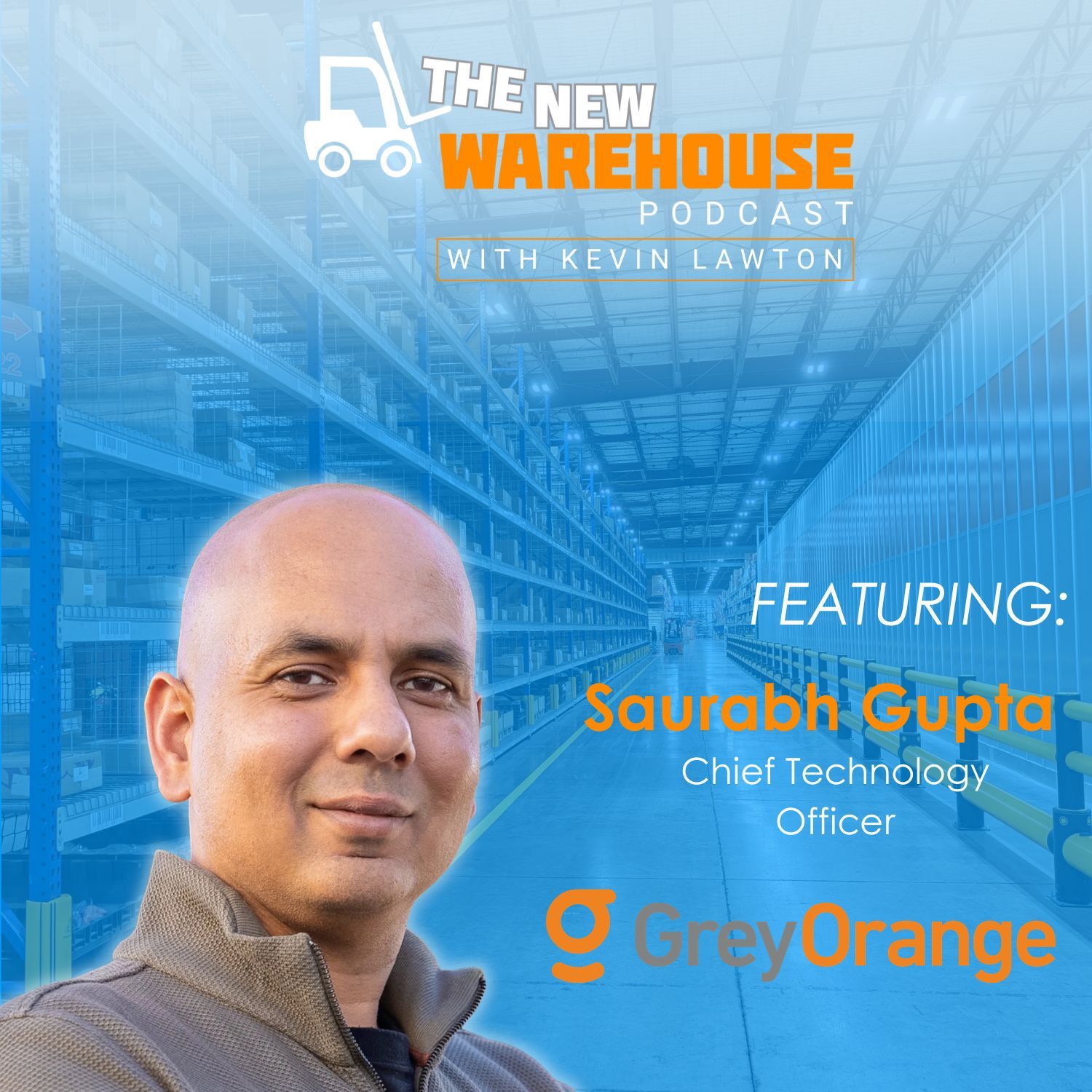
Welcome to this episode of The New Warehouse Podcast, featuring Saurabh Gupta, CTO of GreyOrange. The company began by building warehouse robots. It has since expanded its focus toward software and physical AI orchestration across fulfillment, manufacturing, and retail.
Gupta joins Kevin to discuss what physical AI orchestration actually means for warehouses. They explore the evolving relationship between WMS and WES platforms, the shift from simulation to automation, and AI’s growing role in warehouse execution. The conversation also raises an important question for warehouse leaders: Is adding more automation enough if the systems still operate independently?
Physical AI Orchestration Breaks Down Automation Silos
Warehouses have steadily replaced manual processes with automated ones. But Gupta argues that automation alone does not solve the larger operational problem. “Where automation failed is that you eventually went from having these independent manual systems to independent automated systems; there are still silos.”
Physical AI orchestration connects those systems around a common operational objective. “Orchestration really is all about how you make sure that these individual systems can interact in the most organic possible way. There is unified intelligence which coordinates what is happening, and truly it is a system that takes away those silos within a warehouse.”
That requires coordination across robots, people, conveyors, and other automation. It also changes how warehouse software works together. Gupta describes the WMS as the system of record and the WES as the system of action. The WES determines how the operation executes against the objectives established by the WMS.
Build the Software Before Buying the Hardware
Gupta’s recommendation for warehouses considering automation is straightforward. “It’s absolutely build the software first.” Rather than designing a facility and adding software afterward, he says the software layer should help shape the design itself.
“Because the software foundation is what helps you model the facility, understand your throughput requirements, go simulate different kinds of stress conditions that happen at different stages of the lifetime.” That modeling can reveal expensive assumptions before equipment reaches the floor.
For example, GreyOrange’s Foundry simulation suite can model inventory flow under different operating conditions. Gupta says customers sometimes discover that “70% of the capacity that you have would be largely unused throughout the year.” Simulations can also expose hidden choke points. A robot failure or spill in one aisle could otherwise disrupt the entire system.
The result is a different automation conversation. Instead of asking what technology to buy, operators can first determine what the operation actually needs.
AI Shifts Warehouse Workers Toward Higher-Level Decisions
Physical AI orchestration is not limited to coordinating warehouse automation. Gupta believes it can also change how warehouse employees spend their time. Workers currently make countless small decisions about priorities, inventory, late orders, and what happens next.
“And what our system does is really solve this, what we call the decision fatigue problem.” Gupta envisions workers managing broader operational outcomes while AI handles repetitive decisions at much greater speed. “We want the warehouse workers to be upleveled.”
That philosophy extends to warehouse software itself. Gupta expects interfaces and software applications to become less visible as AI improves. “The best technology is one that’s completely invisible.” In his vision, warehouse leaders communicate objectives while technology manages more of the execution behind the scenes.
Even the measure of good software is changing. “Our metric is: do people ever have to interact with the system, right?” The goal is not more screen time. It is an operation that increasingly anticipates, adapts, and works autonomously.
Key Takeaways
- Automation does not eliminate silos – Warehouse orchestration coordinates independent systems toward common throughput and operational goals.
- Software should influence automation design – Modeling and simulation can expose bottlenecks and unnecessary capacity before hardware investments are made.
- Designing for peak can be expensive – Gupta says simulations can reveal cases where 70% of planned capacity would remain unused most of the year.
- Flexibility matters after deployment – A software-led architecture can allow operators to change hardware or automate new bottlenecks as requirements evolve.
- AI can reduce decision fatigue – Warehouse employees can focus on higher-level objectives while software handles more routine operational decisions.
Listen to the episode below and leave your thoughts in the comments.
Guest Information
For more information on GreyOrange, click here.
To connect with Saurabh Gupta on LinkedIn, click here.
For more information about physical AI orchestration, check out the podcasts below.
Improving Supply Chain Visibility Starts with Warehouse Execution
Warehouse Execution Systems: Optimizing People, Processes, and Automation

Physical AI Is Taking on Warehouse Variability » The New Warehouse
[…] Physical AI Orchestration for Warehousing Starts with Software […]