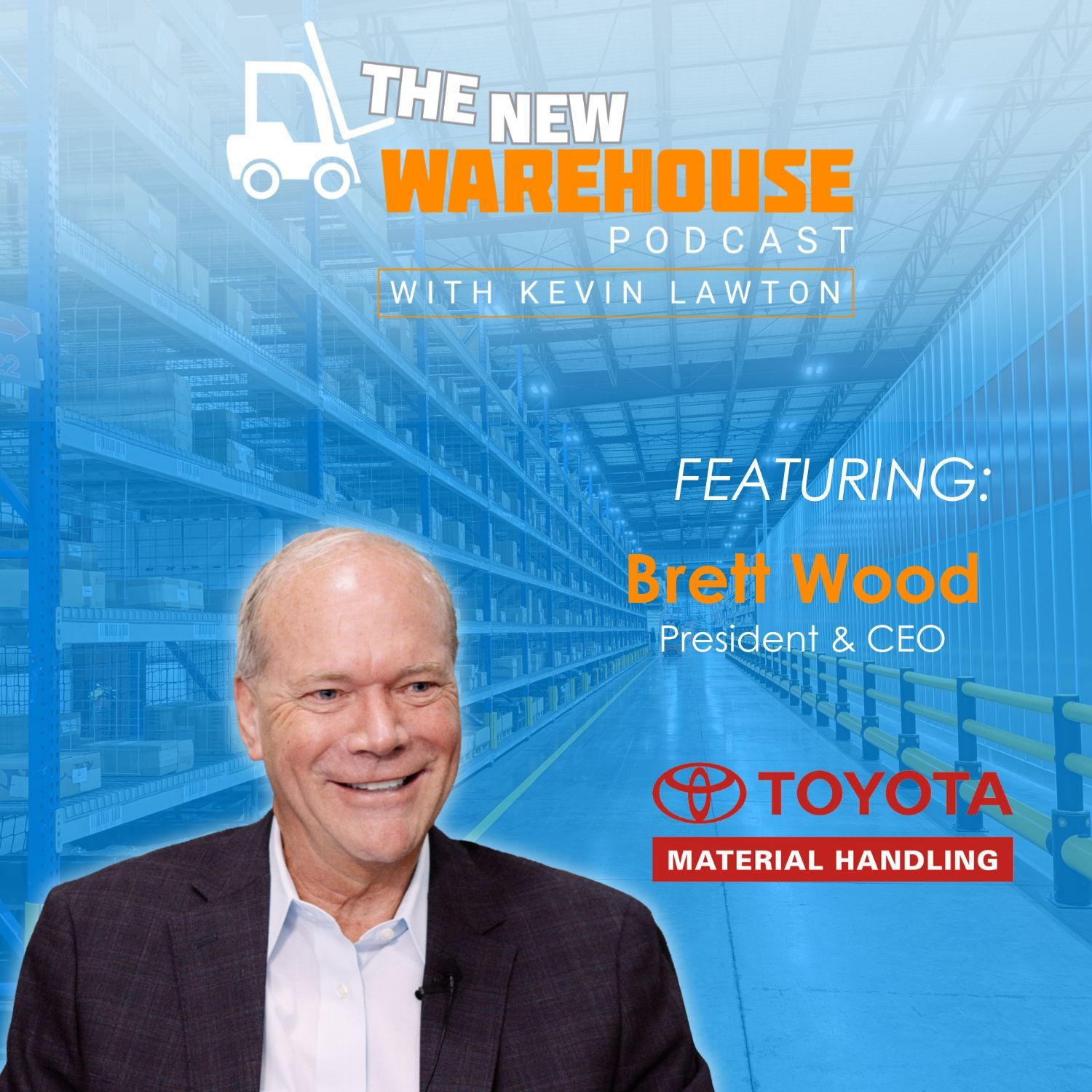
Toyota Material Handling: Insights on Forklift Technology with Brett Wood
Welcome to this episode of The New Warehouse Podcast, recorded at Toyota Material Handling North America’s headquarters in Columbus, Indiana. Kevin is joined by Brett Wood, President and CEO of Toyota Material Handling North America.
Wood looks at where forklifts and material handling are heading next. The conversation covers electrification, automation, operator experience, customer-driven innovation, and Toyota’s long-term strategy. The discussion comes as Toyota Material Handling opens a new electric forklift factory and expands its broader material handling capabilities across North America. It also shows how a major equipment manufacturer is preparing for rapid technology change without losing sight of the people using it.
Electric Forklifts Move Toward the Mainstream
Forklifts touch far more of the supply chain than most people realize. Wood puts it simply: “everything you own, everything you eat or drink probably was handled by a forklift somewhere.” Toyota’s North American factories now build about 400 forklifts each day.
Increasingly, those forklifts are electric. Electric models represented about 66% of the market in 2023. According to Wood, “In 2025, just a couple of years later, it grew to 70%.” Cities such as Chicago and Boston are already around 80% electric. Wood expects the shift to continue as motor and battery technology improve. Toyota is backing that outlook with a new Columbus factory dedicated solely to electric equipment. The $100 million investment also creates 140 new jobs.
Automation Has to Fit the Operation
Automation is advancing, but Wood does not treat it as an automatic choice. “Are customers considering automation? I would say yes, considering.” The business case depends on the operation.
Hours, shifts, fleet size, workforce availability, and local labor costs all matter. Those factors can make the same automation investment compelling in one facility and unnecessary in another.
Wood is especially interested in semi-automated equipment. A forklift could remain operator-driven during the day, then support an automated second shift when labor is scarce. “Flick a switch, now that forklift could be automated.” That model could give warehouses a more flexible path into automation.
It also reframes the technology decision. Instead of asking whether to automate everything, leaders can identify where automation solves a specific capacity or labor problem.
For Toyota Material Handling, Innovation Starts by Seeing the Work
Toyota’s approach to innovation begins with customers. Wood asks, “What do customers want?” Then he gives the obvious next step: “Well, let’s go ask the customers.”
That thinking is captured in genchi genbutsu. “It means go and see with your own eyes.” Wood says his product planning team once had to visit at least 20 customers every year. Those visits helped reveal problems operators faced in real environments.
Toyota Material Handling carries that customer focus into its long-term strategy. “The four pillars are respect for people, serve customers first, pursuit of excellence, and partner for success.” The company plans around a five-year horizon rather than the next quarter.
For warehouse leaders, the lesson is useful. Technology can move quickly, but better decisions still begin with people, customers, and firsthand observation.
Key Takeaways from Toyota Material Handling
- Electric forklifts reached 70% of the market in 2025, up from about 66% in 2023.
- Chicago and Boston are already around 80% electric.
- Automation decisions should reflect shifts, fleet size, labor availability, and local labor costs.
- Semi-automated forklifts could provide a flexible path between manual and autonomous operation.
- Toyota’s four pillars keep people, customers, excellence, and partnerships at the center of its strategy.
Listen to the episode below and leave your thoughts in the comments.
Guest Information
For more information on Toyota Material Handling, click here.
To connect with Brett Wood on LinkedIn, click here.
For more information about Toyota Material Handling, check out the podcasts below.
543: Toyota Material Handling’s Next-Gen Distribution Center
Toyota Automated Logistics on ASRS Strategy, Integration-First Solutions & Lifecycle Support