Physical AI in Warehousing: Berkshire Grey
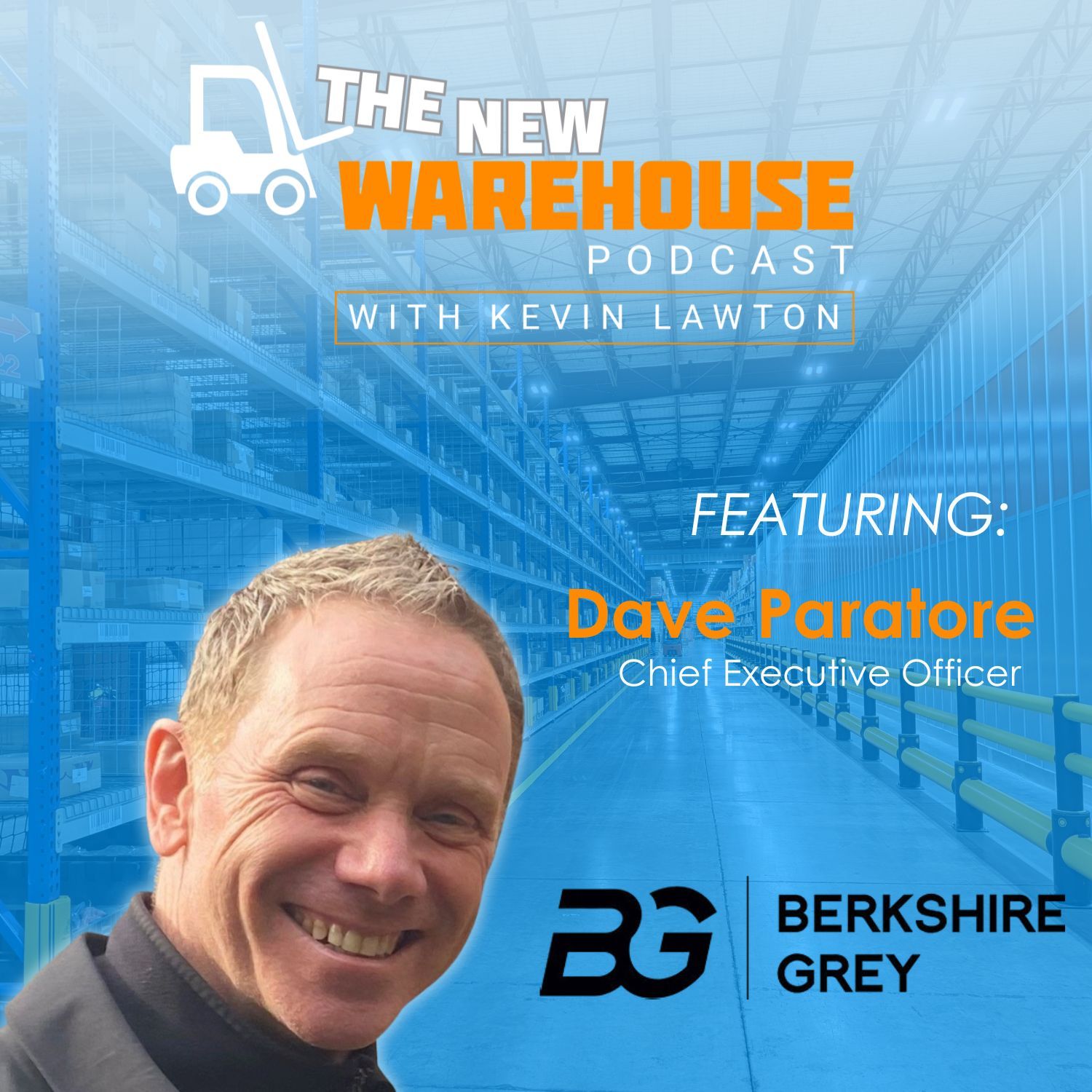
On this episode of The New Warehouse Podcast, we jump into the topic of physical AI in the warehouse. Kevin is joined by Dave Paratore, CEO of Berkshire Grey, to explore physical AI’s growing role inside modern warehouses. If you aren’t familiar with Berkshire Grey, they develop AI-enabled robotics for picking, sortation, and trailer unloading. Dave explains how these systems perceive changing conditions, make decisions, and complete physical tasks.
Physical AI in Warehousing Connects Decisions to Action
Physical AI is ideal for warehouses as it allows machines to interpret unpredictable surroundings without programming every possible condition. According to Dave, “It’s really about increasing the ability for that machine to work in a variable environment and make those decisions.”
Dave describes that transition directly: “AI in our world is that transition from discretely programming things to a system that can interpret and make decisions in a highly variable space.”
The second half is physical execution. As Dave puts it, “And then you combine that with the physical execution of that.” A system must evaluate its vision, capabilities, and surroundings. It then turns those inputs into a task.
Physical AI in Warehousing Tackles Real Complexity
A mixed trailer may contain cartons, poly bags, tires, pallets, kayaks, and other non-conveyable items. Dave explains, “This is where AI becomes an enabler… to identify those things before they get on the conveyor.” The system must also alert an operator who may not be nearby.
Berkshire Grey applies AI internally, too. “Yes, we absolutely use AI in our products, but we also now use it in our processes.” That includes faster software development and quicker integration.
Still, customers want proof under real conditions. Berkshire Grey invites them to test their actual inventory. “Bring your SKUs. Send us 500 of your SKUs.” Dave adds, “You can see how well it works. You can time it with your own stopwatch”
Physical AI in Warehousing Expands Automation’s Reach
The strongest evidence of progress is SKU eligibility. Robotic picking once addressed only a limited share of a customer’s assortment.
Dave notes, “if you go back five or seven years ago, a pick cell functioned, but maybe the SKU eligibility, of someone’s, of someone’s SKU set was 60%, 65%, and now you’re closer to 80 to 85%.”
Berkshire Grey has since reached another milestone. “We just had one of our first customers where we’re very proud to say we had 100% SKU eligibility.” Dave says that result was not possible three or four years ago.
The opportunity now extends beyond picking. “How many more complex loads can you handle?” Dave asks. Speed follows capability, but performance remains multidimensional: “They want accuracy, they want throughput, they don’t want damage.” He believes physical AI will advance in these areas as it handles more products, environments, and workflows.
Key Takeaways
- Variable environments are replacing narrowly programmed automation use cases.
- Pick-cell SKU eligibility has risen from roughly 60–65% to 80–85%.
- Berkshire Grey recently achieved 100% SKU eligibility for one customer.
- Adoption depends on accuracy, throughput, damage prevention, and proof using real inventory.
Listen to the episode below and leave your thoughts in the comments.
Guest Information
For more information on Berkshire Grey, click here.
To connect with Dave Paratore on LinkedIn, click here.
For more information about physical AI in warehousing, check out the podcasts below.
Unit AI: They Don’t Sell Robots, They Sell Capacity