Warehouse Automation Trends from MODEX 2026
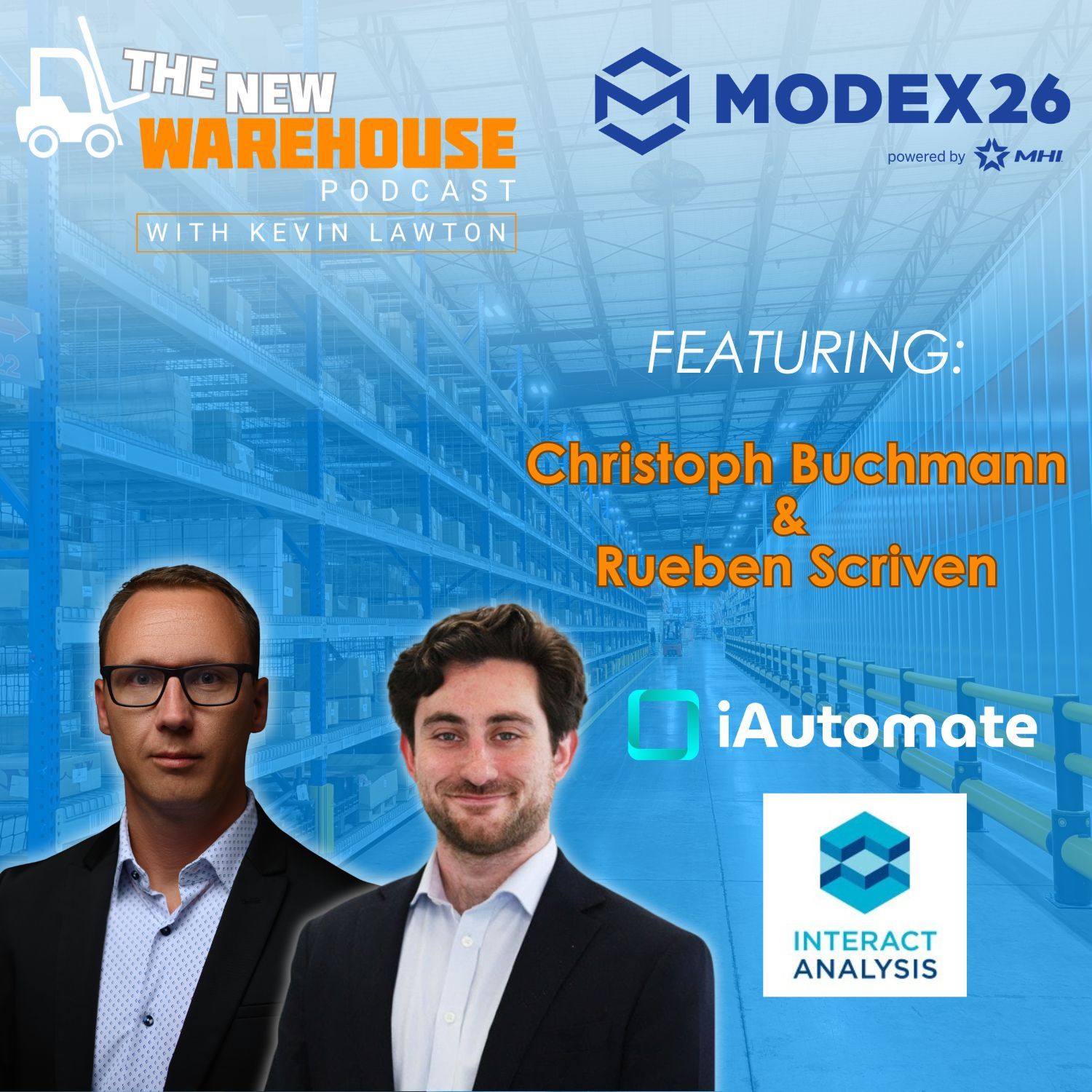
Welcome to this episode of The New Warehouse Podcast, where Kevin chats with Christoph Buchmann of iAutomate and Rueben Scriven of Interact Analysis. Together, they break down what they saw at MODEX 2026 and LogiMAT. The discussion goes beyond show-floor hype and focuses on what warehouse operators actually care about right now. For leaders evaluating automation, this episode offers a grounded look at where the market is heading and what matters most in real operations.
Warehouse Automation Trends Are Becoming More Practical
At MODEX 2026, there was strong interest in automation, but buyers appeared more selective. Christoph Buchmann said he has been hearing “a bit of a technology fatigue.” He explained that many vendors lead with features while operators stay focused on outcomes. As he put it, “they’re focusing on selling us on their tech versus what really matters from an operational point of view is uptime. How reliable is that system?”
That shift matters. Warehouse leaders still want lower cost per pick, space savings, and stronger throughput. However, they are less impressed by novelty alone. Buchmann added that some solutions are becoming over-engineered, which can distract from performance.
This creates a healthier market. Buyers are asking harder questions about service levels, ROI, and daily execution. That is a sign the industry is maturing. Instead of chasing the newest concept, operators want dependable solutions that improve the business.
AI Is Here, But Real Use Cases Matter
AI remained a major topic at MODEX. Still, the conversation is changing. Rueben Scriven noted, “AI’s been on every single stand for the last three, four years.” What stood out this year was the movement toward practical applications.
Scriven said, “There are some more functional use cases.” He grouped current warehouse AI into four categories: vision and inspection, execution and optimization, natural language interaction, and physical AI such as humanoids. Among those, vision appears to be gaining the most traction.
He explained, “There seems to be a lot of use cases at the show around vision inspection.” That makes sense. Vision tools can improve quality control, detect issues faster, and often leverage existing camera infrastructure.
Meanwhile, humanoid robots drew less buzz than expected. Safety and regulation remain barriers. The bigger takeaway is clear: AI excitement alone is no longer enough. Buyers want useful, measurable applications that fit real warehouse workflows.
Reliability and Integration Still Decide Deals
When operators were surveyed, the top barrier to adoption was not cost. It was complex. Scriven shared, “In fact, it was integration complexity.” That finding says a lot about today’s market.
Most warehouses already run layered systems. New automation must connect with WMS, controls, labor processes, and changing order profiles. If that feels risky, decisions slow down. Buchmann echoed that concern, saying, “The integration complexity, I think, is the biggest fear.”
Even after evaluating newer technologies, many buyers return to proven options. Buchmann said some companies go back to systems that “just works.” That decision often reflects career risk as much as technical risk.
Scriven added another key truth: “Reliability is fundamentally probably the most important factor.” In the end, uptime, support, and confidence often beat flashy demos. For vendors, that means trust may be the strongest differentiator in the market.
Key Takeaways
- Operators are prioritizing uptime, reliability, and ROI over flashy features.
- Technology fatigue is emerging as similar solutions flood the market.
- AI is evolving from branding language into practical use cases.
- Vision inspection technologies ranked high in terms of future investment interest.
- Interact Analysis surveyed about 400 operators for recent findings.
- Integration complexity was the number one barrier to automation adoption.
- Scalability matters more because future demand remains uncertain.
- Proven systems often win because they lower operational and career risk.
- Humanoid robots generated less buzz than many expected at MODEX 2026.
Listen to the episode below and leave your thoughts in the comments.
Guest Information
For more information on iAutomate, click here.
For more information on Interact Analysis, click here.
To connect with Christoph Buchmann on LinkedIn, click here.
To connect with Rueben Scriven on LinkedIn, click here.
For more information about warehouse automation trends, check out the podcasts below.
The Buyer’s Journey for Warehouse Automation
Warehouse Automation Success Depends on Operational Alignment

Material Flow Optimization Beyond Traditional Forklifts
[…] Warehouse Automation Trends from MODEX 2026 […]
Warehouse Automation Market: Insights from Interact Analysis
[…] Warehouse Automation Trends from MODEX 2026 […]