Shared Autonomy Brings Human Judgment to Autonomous Forklifts
Warehouse leaders are no longer debating whether automation belongs in the operation. According to Arshan Poursohi, CEO and co-founder of Third Wave Automation, the conversation has moved on. “The question is almost never ‘should we automate?’ Everyone has already answered that.” What he hears instead is, “Where do we start?” And beneath that is another concern: “Is our facility even the kind of place where this works?” Automation looks flawless on a demo floor. The real test happens when the routine breaks down: a pallet blocking an aisle, an oversized load, or a loose shrink wrap. In autonomy, those moments are called exceptions.
There is no Perfect Facility for Autonomous Forklifts
Most warehouses in the U.S. are over four decades old, with 25% over fifty years old. But exceptions are not uniquely a brownfield problem. A purpose-built site opened last year sees them too. As Poursohi puts it, “We start with the assumption that there is no perfect facility. That’s just a pipe dream.”
Loose shrink wrap is a simple example. An experienced forklift operator can look at it and decide whether the forks can safely pass through without damaging the load. An autonomous truck may need help making that call. Push-back racking creates another challenge because pallet position, resistance, contact, and alignment all matter.
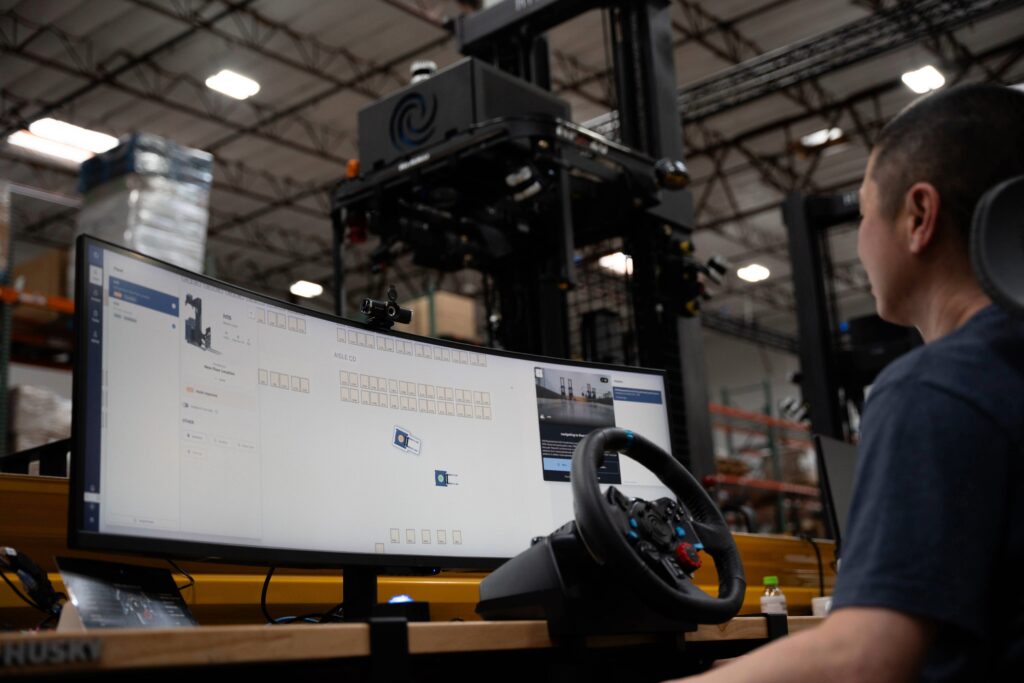
This is where Third Wave’s operator station comes in. Poursohi explains the thinking simply: don’t just train the machine to know what to do; also train it to ask for help when it doesn’t know what to do. Rather than leaving the truck stuck or forcing the automation to make a decision, a remote operator can step in, resolve the exception, and return the truck to autonomous operation in a matter of seconds.
Third Wave + Armada Case Study: 99.94% Inventory Accuracy, Zero Safety Incidents
Shared Autonomy: Human Judgment When Experience Matters
The trucks handle the routine work, but Third Wave deliberately leaves room for human judgment when the automation encounters an issue. As Poursohi explained in an interview with FreightWaves, “What we did with our tech is embrace the notion that the robot recognizes when it doesn’t know how to do something, and it asks for help, actively.”
Third Wave says one remote operator can oversee 10 or more forklifts, with exceptions resolved in seconds. That changes the role of the operator. Instead of spending the shift making repetitive moves, that person can focus on exceptions, decisions, and the situations where human judgment actually adds value.
Age is not the variable. A warehouse opened last year still deals with misplaced inventory, inconsistent pallet conditions, congested aisles, different rack configurations, and the everyday surprises that come with moving freight. Shared Autonomy is built around that reality, not the assumption that every move will go exactly according to plan.
Measuring the ROI of Autonomous Forklifts
Shared autonomy starts to feel less like a technology concept and more like an operating model when you look at where the value actually shows up. It is not just about reducing repetitive forklift travel. Inventory accuracy, rack damage, and the ability to keep customer commitments all become part of the equation.
Poursohi says some of those costs were bigger than he expected. “The cost of lost pallets was surprising to me. Aside from that, rack damage… it’s a huge interruption when it does happen.”
Third Wave points to a deployment in Romeoville, IL, with Armada Supply Chain Solutions. At Armada, directed putaway places every pallet exactly where the system specifies rather than at the nearest open location, which the company estimates saves approximately $7,500 per month in misplaced and lost pallet recovery costs alone. Combined with broader operational efficiencies, Armada estimates total savings of $18,000 per month with a four-truck deployment. None of it required a teardown, a rebuild, or any fixed infrastructure. Armada reports 99.94% inventory accuracy, zero safety incidents, and zero racking damage across 25,863 pallet moves.
Those results put real numbers behind the operating model. The forklifts handle the repetitive work, while people remain available when human judgment is needed. Poursohi says that local knowledge still matters. “The people that work there are super valuable, ’cause they know where stuff is. They know how it’s supposed to work.” That experience becomes even more important when the system encounters something outside the normal flow.
That approach is also emerging across a much broader material-handling ecosystem. In June, Third Wave announced a collaboration with The Raymond Corporation to bring its automation technology to select Raymond lift trucks. The initial lineup includes an automated Swing-Reach truck, with the companies also targeting workflows such as dock-to-dock movement and trailer loading and unloading.
How Does Automation Respond When It Needs Help?
For warehouse operators considering autonomous forklifts, the real question may not be whether the truck can handle routine tasks. It’s how the truck responds when something unexpected happens on the floor. Third Wave’s Shared Autonomy model is built around that reality. The trucks handle the repetitive work, and a person steps in when judgment is needed.
If autonomous forklifts are on your radar, contact Third Wave Automation.