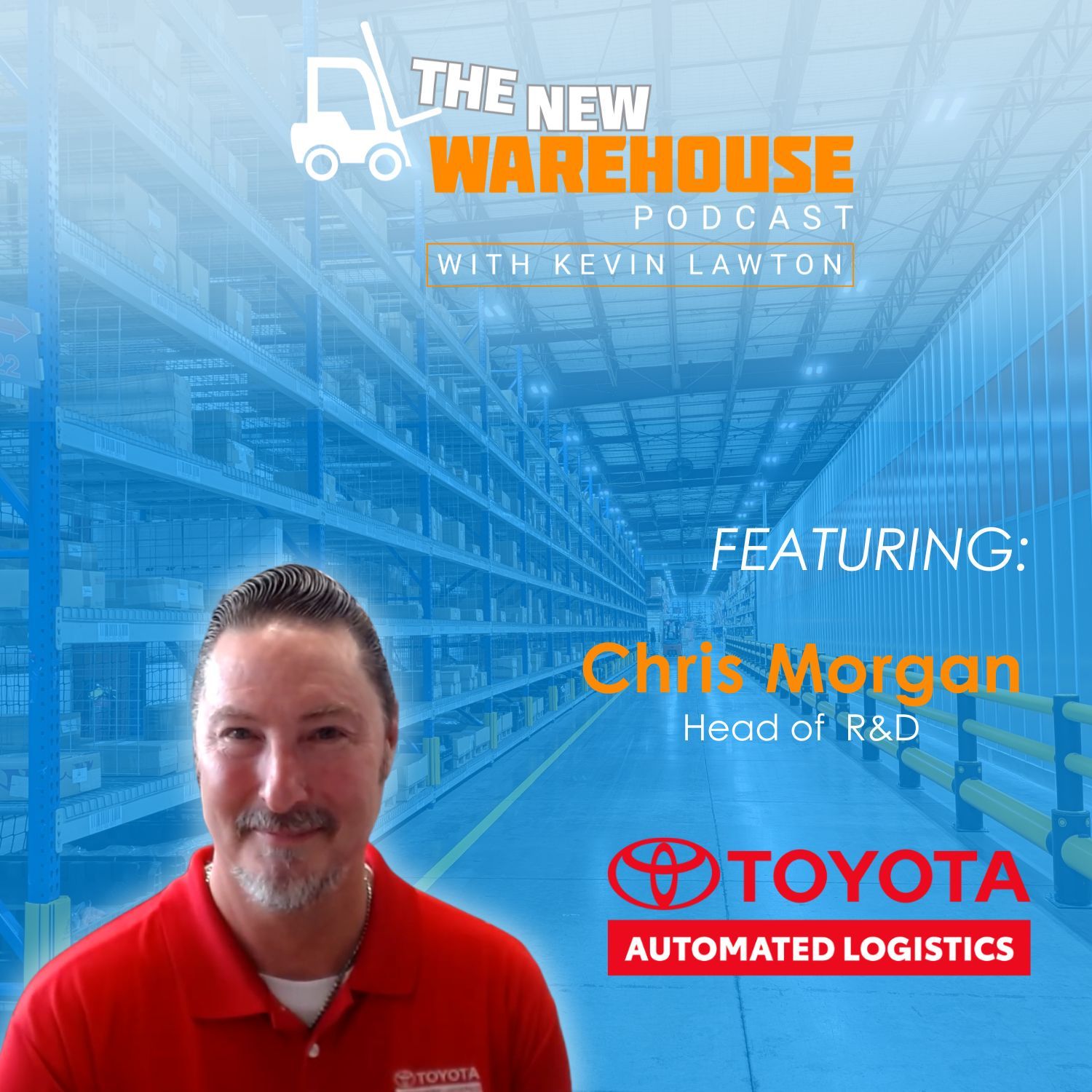
Building the Warehouse of the Future Like Legos: Toyota Automated Logistics
Warehouse automation is advancing quickly, but choosing the right technology is getting harder. On this episode of The New Warehouse Podcast, Kevin welcomes Chris Morgan, Head of R&D at Toyota Automated Logistics. Morgan works across emerging technologies, new product development, robotics, and warehouse systems.
The conversation explores where warehouse automation is headed and what operators should be watching now. Morgan discusses flexible robotics, computer vision, shared data, and smarter warehouse systems. He also explains why the best technology still starts with understanding the customer and the operation.
Cutting Through the Automation Noise
Warehouse operators have more technology options than ever. That abundance can make taking the first step difficult. Morgan sees cost, change management, and uncertainty around ROI as common barriers. Automation can sometimes achieve payback in two to three years, but companies still need confidence in the path forward.
“There’s a lot of noise coming in right now with the advancements of AMRs, AI, and vision-picking technology. This has many people wondering: “How do I get started? And what makes the most sense for me?” Morgan said. The answer does not begin with selecting the newest robot. It begins with understanding what the operation actually needs.
“This isn’t cookie-cutter. It’s definitely not a one-size-fits-all.” Different customers have different workflows, maturity levels, labor challenges, and technology environments. Morgan argues that technology should fit those realities rather than force the warehouse into a predetermined solution.
Computer Vision Can Do Much More Than Pick
Morgan sees computer vision as one of the biggest opportunities on the warehouse floor. Cameras already support product identification, picking, palletizing, navigation, and robotic movement. The bigger opportunity comes from using those same systems to capture more operational intelligence.
“Think of all the different jobs inside of a warehouse or a manufacturing facility that vision can enable.” An automated reach truck, for example, could identify a pallet for pickup while also spotting misplaced inventory or a leaning pallet 25 feet in the air.
That changes vision from a task-specific tool into another source of operational awareness. “Let’s take advantage of them. Put them to work for us and make them think more like humans.” That information could warn people, reroute robots, or help another system respond before a problem worsens.
How Modular Automation Is Reshaping the Warehouse
Morgan expects future warehouses to become far less fixed. Instead of building operations around equipment that stays in one place for years, warehouses could increasingly reconfigure technology as demand changes.
“The warehouse of the future is a really dynamic, flexible area. I think it’s gonna feel more like Legos.” That could mean more AMRs, automated guided vehicles, mobile robotic picking systems, and eventually more modular robotic platforms.
The intelligence inside those systems will matter just as much. “We’re giving the robots more freedom of understanding to share information and make adjustments as necessary, right?” Morgan envisions robots learning from one another and warehouse systems sharing more information across the floor.
Key Takeaways
- Automation is not one-size-fits-all; operators need solutions aligned with their specific workflows and needs.
- Computer vision can extend beyond picking into safety, inventory visibility, exception detection, and navigation.
- Edge computing and shared data can help robots and warehouse systems make faster decisions on the floor.
- Future warehouses will become more modular, like Legos. This will allow operators to reconfigure automation as volumes and requirements change.
Listen to the episode below and leave your thoughts in the comments.
Guest Information
For more information on Toyota Automated Logistics, click here.
To connect with Chris Morgan on LinkedIn, click here.
For more information about building the warehouse of the future, check out the podcasts below.
Yard Automation and the Future of the Yard
Flexible Warehouse Automation and the Future of Fulfillment
636: Robotics, Software, and the Future of Humanoids in Warehousing