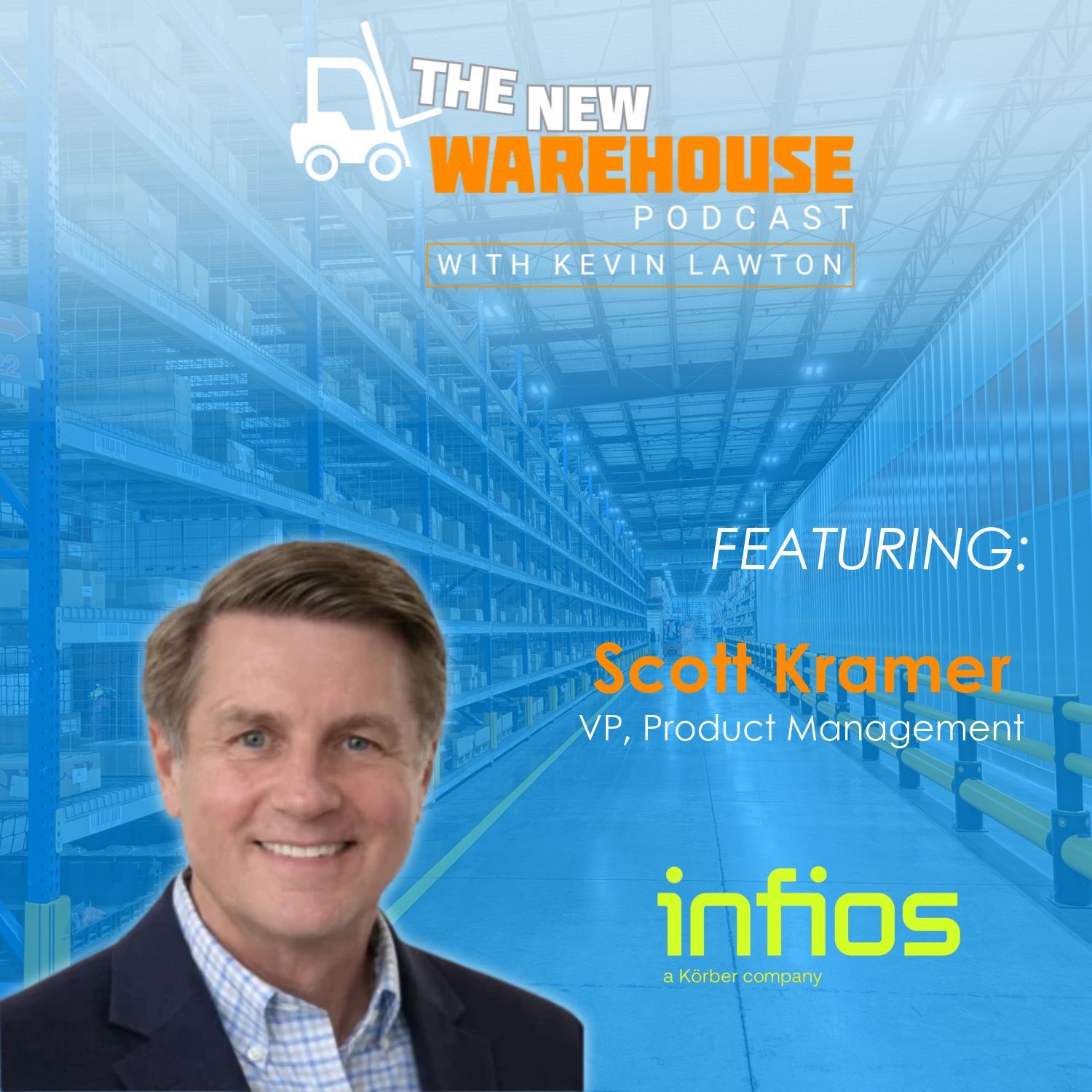
AI in Warehouse Management: Moving from Reaction to Action
Welcome to The New Warehouse Podcast! In this episode, Kevin welcomes Scott Kramer, Vice President of Product Management for Warehouse Management at Infios, to discuss how artificial intelligence is changing warehouse operations.
Infios develops supply chain execution technology connecting order management, warehousing, and transportation. Kramer explains how AI in warehouse management is helping bridge the gap between identifying operational problems and taking action.
Real-Time Visibility Doesn’t Prevent Warehouse Problems
For years, warehouse operators have invested in systems that provide faster, more accurate information. But knowing a truck is late or equipment has failed doesn’t necessarily leave enough time to prevent disruption.
“I can get more real-time visibility. I can get more accurate information, but ultimately, there’s still a lag,” Kramer explained.
Predictive AI in warehouse management offers another approach. Instead of waiting for a problem to appear, systems could identify developing labor shortages, equipment failures, or transportation delays. Managers would have an opportunity to adjust staffing, change priorities, or reroute work before shipments are affected.
Seasonal demand presents another challenge. Traditional warehouse management systems often rely on product velocity to determine slotting decisions. Those calculations may struggle to keep pace with changing demand during peak season.
“If I wait for the system to maybe detect it, it may be too late, right?” Kramer said.
Using forecasts and historical trends, warehouses could anticipate changes in product movement rather than waiting for order activity to reveal them.
Building Trust Before Giving AI Control
Introducing AI in warehouse management raises an important question. How much decision-making should operators hand over to technology?
Kramer compares the process to developing a new employee. “When we think about an agent, I think we have to consider them like an intern at the beginning.”
Infios describes its approach as graduated autonomy. AI agents initially help employees retrieve inventory information, investigate exceptions, and understand operational performance. As they learn a facility’s workflows, they can progress toward recommending actions and handling routine decisions.
For example, an agent could eventually recognize an expedited order requiring replenishment and automatically increase its priority. Reassigning employees because of a delayed inbound truck would still warrant human approval.
Trust also requires visibility into the agent’s decisions.
“I think the other part, though, is I need to be able to validate and understand what the agent did.”
Audit trails, configurable guardrails, and ongoing training allow operators to evaluate AI performance before expanding its responsibilities.
Giving Warehouse Leaders Their Time Back
Consider how much time a supervisor spends resolving one operational exception. The notification might take 30 minutes to arrive, followed by another 10 to 20 minutes of investigation and additional time coordinating a response.
“So between problem, instantiation and resolution, I might be well over an hour. And in a warehouse, an hour’s a really long time, right?” Kramer said.
Now imagine an AI agent identifying the warning signs, checking orders, shipments, labor availability, and inventory, then presenting a recommended action. In Kramer’s illustrative scenario, that process could shrink resolution time from roughly an hour to a minute.
“So I just saved myself fifty-nine minutes of resolution time, not to mention the, let’s say, twenty or thirty minutes of me physically going in and doing all the research and analysis.”
That time has implications beyond the immediate problem. Experienced warehouse leaders are frequently pulled into resolving exceptions when they could be improving processes, coaching employees, or developing new services.
For Kramer, the opportunity is to give those people more time to improve operations instead of constantly responding to problems.
Key Takeaways on AI in Warehouse Management
- Real-time visibility isn’t enough. Predictive AI could help operators address disruptions before they affect warehouse performance.
- AI autonomy should be earned. Begin with assistance and recommendations before allowing agents to make decisions independently.
- Human oversight remains important. Complex decisions, particularly those affecting staffing, still benefit from supervisor approval.
- Faster exception resolution creates capacity. Reducing investigation time could free experienced leaders to focus on improvements and employee development.
Listen to the episode below and leave your thoughts in the comments.
Guest Information
For more information on Infios, click here.
To connect with Scott Kramer on LinkedIn, click here.
For more information about AI in warehouse management, check out the podcasts below.
Warehouse Improvement Through Smarter Project Management
Turning Warehouse Near Misses into Safer Operations with Protex AI
Building the Warehouse of the Future Like Legos: Toyota Automated Logistics