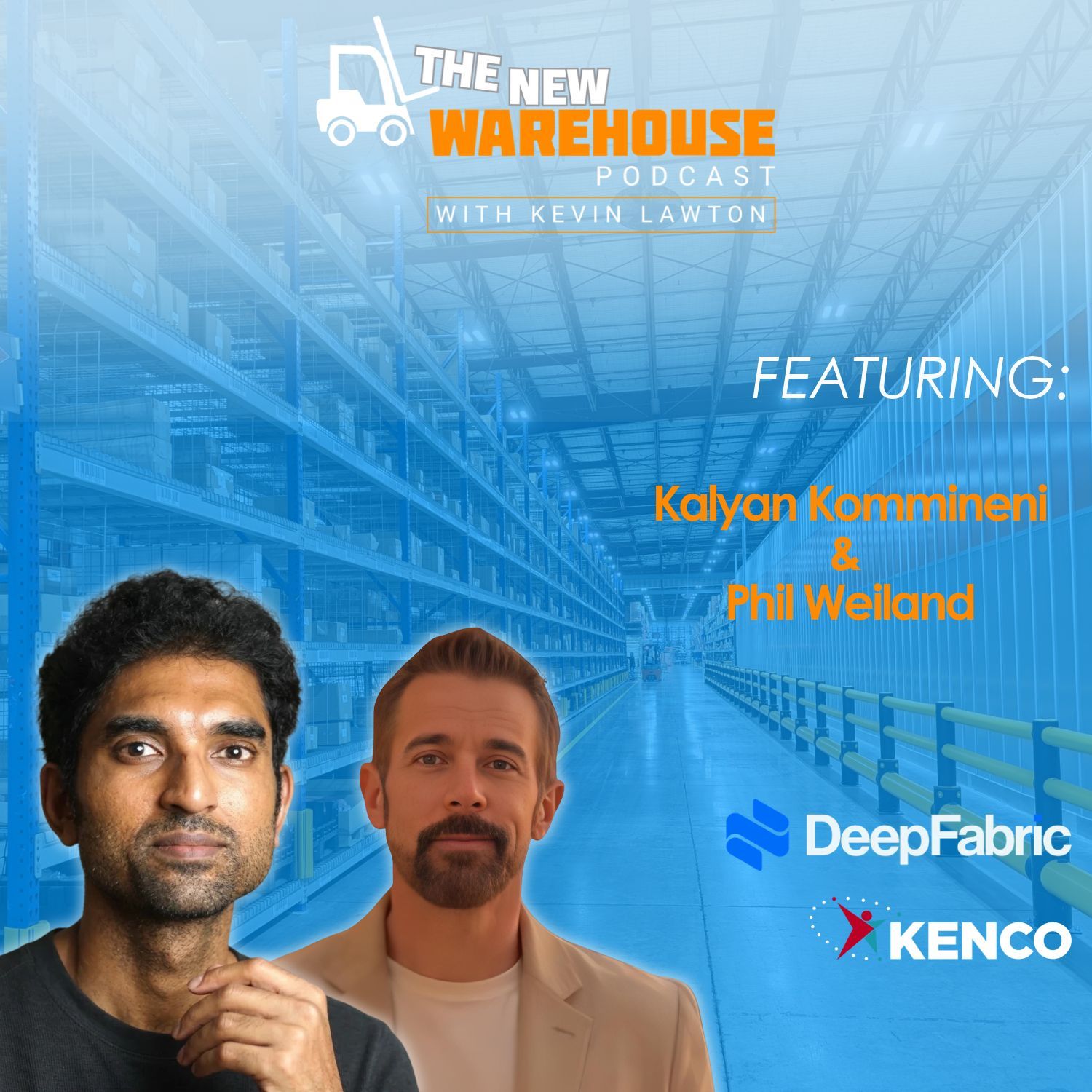
How Kenco and DeepFabric Put AI Agents to Work
Welcome to this episode of The New Warehouse Podcast, where Kevin speaks with Phil Weiland, vice president of IT at Kenco, and Kalyan Kommineni, founder and CEO of DeepFabric.
Kenco, a North American 3PL, put six AI agents into use in about three months. The conversation reveals where the company started, what could have slowed it down, and why employees embraced the changes.
The Real Bottleneck Was Between Systems
Kenco wasn’t looking for an AI project just for the sake of it. Phil saw work piling up between departments, often before employees could decide or help a customer. He describes part of the routine as “grabbing emails, going to look up information in one system, pulling it into a spreadsheet.”
The solutions team offers a concrete example. Responding to an RFP means gathering information from different places, including Kenco’s CRM. Its Solution Fabric helps pull together qualifying bid information for employees to review. Kalyan points to billing as another area where repetitive work accumulates.
Each customer’s contract, services, and billing rules can create a different process. Those differences also have commercial implications. As Kalyan explains, “How efficiently you bill your customers and how efficiently your partners are billing you as a 3PL impacts your proposals, your pricing.”
Don’t Wait for Every Data Problem to Disappear
Kenco moved quickly without giving up ownership or skipping the review process. Every case needed to show business value, follow a clear process, use reliable inputs, and have someone accountable for the rollout. The existing CRM was a practical starting point for the RFP project, while other workflows needed a closer look.
Phil explains the distinction: “You don’t need to solve all the problems with your data, but you need to solve the problems with the data that is needed to drive a process.” Kalyan describes a similar trap among companies attempting AI adoption: “The winning teams try to answer only the questions that matter to their goals instead of trying to answer everything.”
Security and identity still had to be addressed. But Kenco’s teams could meet, decide, and move ahead rather than expand a focused rollout into an endless preparation project.
Employees Helped Build Trust in the AI Agents
Phil didn’t describe a workforce fighting the rollout. Employees welcomed relief from tasks that kept them from serving customers. Kenco also involved those employees in workflow discussions from the beginning. As Phil puts it, “the people that are doing the work are the most important to include early in the process.”
The rollout approach also allowed expansion from smaller groups of sites toward larger ones. Phil explains what employees prefer spending their time on: “things that people enjoy are reviewing the exceptions, solving problems, and you see that at every level.”
Key Takeaways
- Six AI agents in three months – Kenco demonstrates how a focused implementation can move quickly.
- Start with operational gaps or bottlenecks – RFP preparation and site-visit follow-up offer practical examples.
- Focus on data preparation – Resolve the data issues relevant to the workflow rather than every organizational data problem.
- Involve employees early – The people closest to the work helped shape Kenco’s new workflows.
Listen to the episode below and leave your thoughts in the comments.
Guest Information
For more information on Kenco, click here.
For more information on DeepFabric, click here.
To connect with Phil Weiland on LinkedIn, click here.
To connect with Kalyan Kommineni on LinkedIn, click here.
For more information about AI agents in warehousing, check out the podcasts below.
AI Adoption at Walmart: Putting AI in Employees’ Hands
Where is Warehouse Technology Heading with Gary Allen of Ryder?