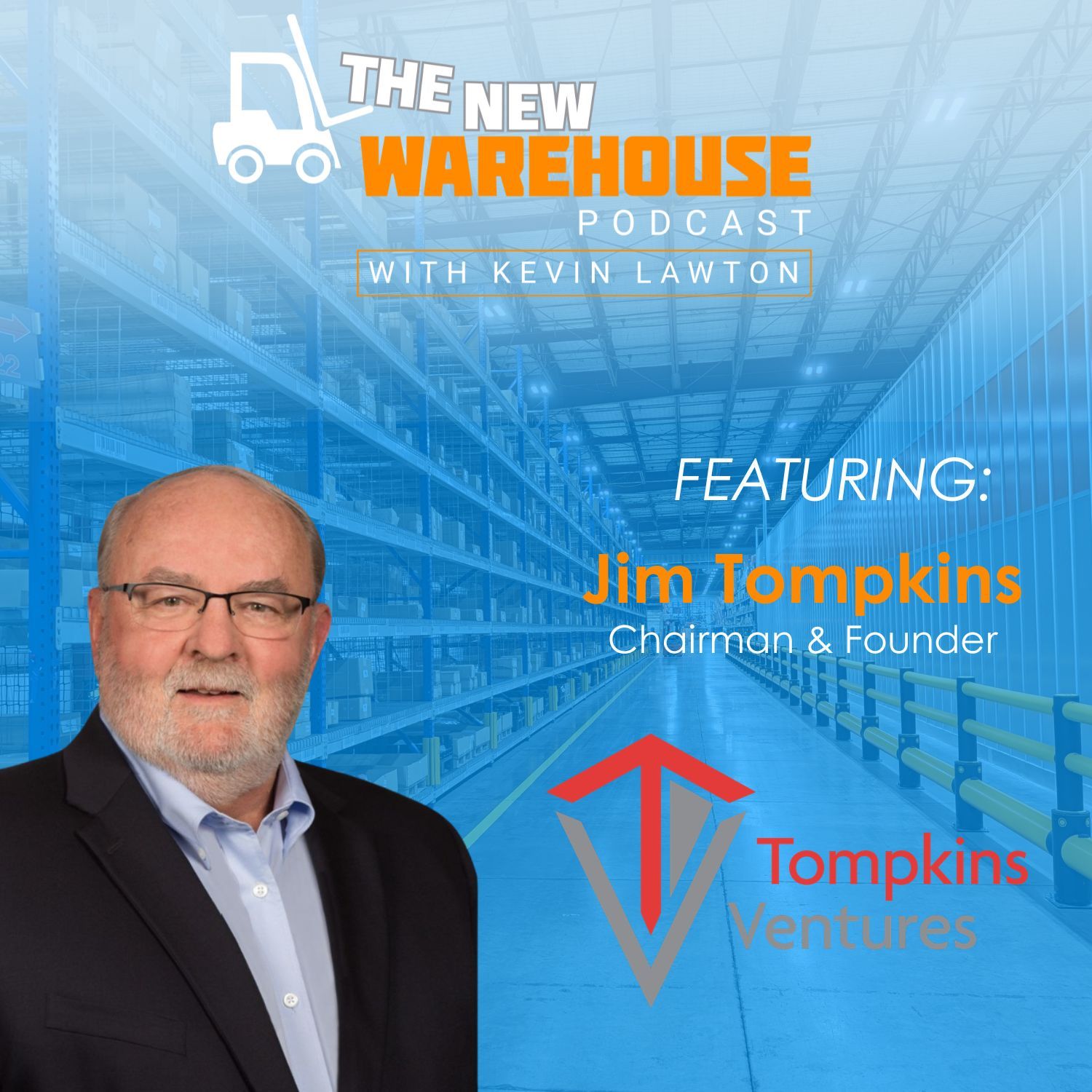
AI-Enabled Warehouses: Insights from Dr. Jim Tompkins
Welcome to this episode of The New Warehouse Podcast, featuring Dr. Jim Tompkins, chairman and founder of Tompkins Ventures. The company connects businesses with an ecosystem of experts through flexible, results-based engagements.
Tune in and hear Tompkins explain why artificial intelligence is moving beyond isolated tools and into enterprise design. Next, he outlines four stages of AI maturity and their implications for supply chain leaders. Tompkins closes with the data, cybersecurity, and leadership disciplines required to build an AI-enabled organization grounded in warehouse operational reality and practical business needs.
From Tool to AI-Enabled Warehouse
Tompkins maps AI across four stages.
- It begins as a tool that improves existing work.
- It becomes a worker when it completes assigned tasks.
- Memory, agentic AI, and autonomous action then make it a partner.
- The fourth stage is more disruptive because companies redesign themselves around the technology.
Tompkins explains, “And we started asking the question, ‘How do we reorganize the company around AI?” And now, oof.” That shift changes both structure and strategy. Leaders retain core capabilities while using AI and outside experts for the rest. An AI-enabled warehouse does not make leadership less important. It makes leadership faster, more selective, and more focused on the next critical move.
The competitive stakes are severe. “Because if your competition does AI and you don’t, you’re toast.” While many companies contemplate job loss from AI, Tompkins adds, “I mean, you’re not gonna lose 70% of your jobs; you’re gonna lose 100% of your jobs.” Pointing out that companies don’t pursue AI to reduce headcount, they must do it to save jobs.
With AI, Warehouse Decisions Move Into Real Time
AI-enabled warehouses begin before the truck reaches the dock. It can improve scheduling, yard movement, door assignments, and container placement. Tompkins argues that poor flow also worsens the perceived driver shortage. “The driver only gets paid when he’s driving, and he’s gonna spend three hours a day sitting in some lounge someplace.”
Inside the building, AI can adjust labor and workflows as conditions change. Tompkins describes a shift that expected 48 people but received 46. AI could reallocate those workers for the next two hours. Later, it could shorten picking waves and isolate 22 urgent orders.
Another example creates a temporary fast-pick line for two shirts and one baseball. That line could process 7% of the day’s orders within an hour. The applications extend through slotting, picking, sortation, staging, and shipping. “And none of this is theoretical. Everything I’ve said in the last two minutes, we’re doing. We’re absolutely doing with AI today.”
Becoming Bigger Than the Payroll
The fourth stage combines AI with fractional expertise and rented capabilities. AI-enabled warehouses retain core competencies while accessing specialists, software, infrastructure, and services as needed. Tompkins explains the scale of that model: “Because what we do is we have the payroll of maybe a thousand people, but the fact of the matter is we’re having the impact of twenty thousand people.”
Human responsibility does not disappear. AI handles retrieval, pattern recognition, summarization, optimization, and monitoring. People remain essential when decisions involve values, priorities, relationships, risk, or trade-offs.
Tompkins offers a clear rule: “If it’s something that has a right answer, let AI do it.” He continues, “If it’s something where you’re looking for a reasonable answer, ask the human to do it, because AI doesn’t have the capability of dealing with emotions and risk and relationships; obviously the human does.” That model depends on quality data and strong cybersecurity governance.
Key Takeaways
- AI maturity progresses from a tool to a worker, partner, and enterprise operating model.
- Competitive planning cycles are shrinking from five years to four weeks.
- AI can reallocate 46 workers, expedite 22 orders, and process 7% of daily volume within one hour.
- Fractional expertise can give a 1,000-person payroll the impact of 20,000 people.
- AI should handle clear answers, while humans own judgment, relationships, risk, and trade-offs.
Listen to the episode below and leave your thoughts in the comments.
Guest Information
For more information on Tompkins Ventures, click here.
To connect with Jim Tompkins on LinkedIn, click here.
For more information about AI-enabled warehouses, check out the podcasts below.
Improving Supply Chain Visibility Starts with Warehouse Execution

John Nofsinger
Jim, I like your conclusion to own core competencies and rent the rest. Somewhat like J Paul Getty’s “own what appreciates, lease what depreciates”. Somewhat things never change.