Warehouse Innovation Starts with Solving Problems
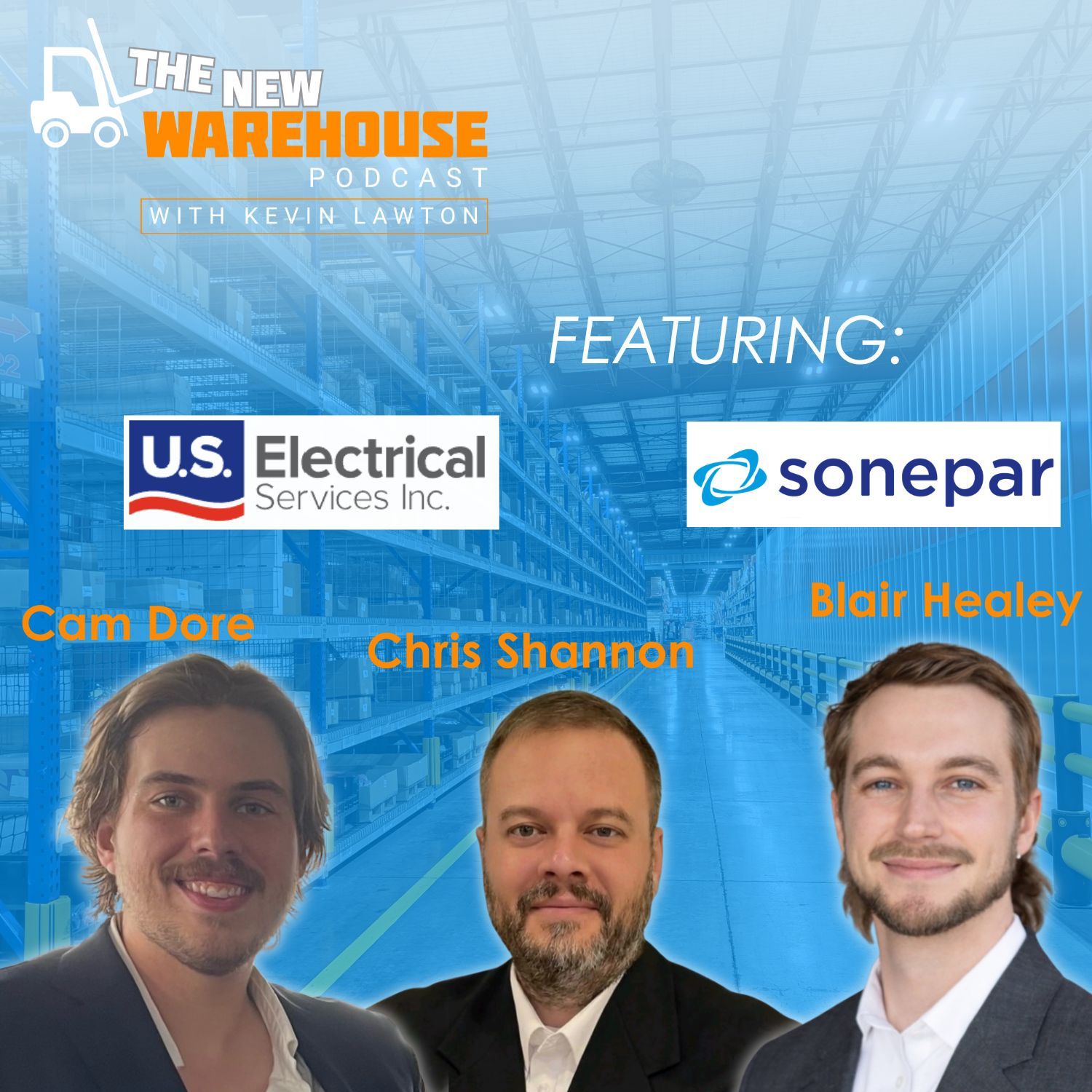
Welcome to The New Warehouse Podcast. In this episode, Kevin speaks with Blair Healey, Supply Chain Implementation Manager at Sonepar US, Cam Dore, Director of Operational Innovation at US Electrical Services (USESI), and Chris Shannon, who oversees distribution center and transportation operations for USESI.
Recorded at the Kardex Experience Lab in Cincinnati, the conversation explores how leading distributors are approaching warehouse innovation through automation and AI. The discussion highlights the role of technologies in service levels, increasing capacity, and helping warehouse teams become more proactive and efficient.
Warehouse Innovation Begins with Better Processes
For both Sonepar and USESI, innovation starts long before automation equipment is installed. As customer expectations continue to evolve, distributors are looking for solutions that can adapt alongside them. Healey noted that “our customer expectations are changing, and they’re continuing to change at a quicker pace as customers are using AI as well.” He also highlighted how AI can serve as a support system for employees, explaining that “it’s kind of a sparring partner, with the team and allows your team to do more than they were doing on their own.”
That mindset extends to automation investments like AutoStore. Sonepar’s approach focuses on long-term scalability, enabling facilities to increase capacity, offer more products, and improve service levels without increasing building footprints.
Automation Creates Competitive Advantages
Dore explained that AutoStore allows USESI to process orders later in the day while still meeting demanding delivery requirements. He noted that many customers operate on tight timelines and may place critical orders late in the evening for next-morning delivery. By automating portions of the fulfillment process, the company can respond more effectively to those requests.
Shannon emphasized that automation is not about reducing headcount. Instead, it helps organizations increase capacity and improve service levels. As he explained, “This allows us to double our capacity, et cetera, with the same staff we have.” He further reinforced the company’s philosophy toward technology adoption, stating, “So it’s not about losing jobs. It’s about how you leverage stuff.”
The discussion also touched on emerging capabilities such as robotic picking and AI-enabled bin induction. These tools can help consolidate orders, reduce manual effort, and create additional operational flexibility while allowing employees to focus on higher-value work.
AI Adoption Requires Leadership and Real Use Cases
USESI uses AI tools such as Replit and Claude to create applications that solve everyday operational challenges. Examples include slotting improvements and customer-facing delivery visibility tools. One internally developed application allows employees and customers to track deliveries in real time, providing immediate value across the organization.
According to Shannon, leaders should focus on solving meaningful business problems first. He explained, “If I don’t say anything else and anybody gets anything from me, it’s understanding a real problem.” That philosophy has helped drive broader adoption throughout the company. Today, more than 25 employees across a 2,500-person organization are actively using AI-powered tools.
For Dore, leadership advocacy has been critical. AI applications are helping supervisors move from reactive management to proactive decision-making. As he explained, “being able to create tools, quickly, cheaply, that allow our supervisors to see proactively, where we’re struggling in a building, really just unlocks potential to improve before there’s a fire drill.” The result is an organization that uses innovation not as a technology initiative, but as a business strategy.
Key Takeaways
- Sonepar and USESI view warehouse innovation as a combination of automation, AI, and process improvement.
- AutoStore provides scalability without requiring building expansion.
- Later order cut-off times help distributors improve customer service levels.
- USESI uses AI tools such as Replit and Claude to develop custom operational applications.
- One internally developed application provides real-time delivery visibility for customers and employees.
- Automation enables higher throughput while maintaining existing staffing levels.
- AI is being used to reduce administrative work and increase employee productivity.
Listen to the episode below and leave your thoughts in the comments.
Guest Information
For more information on Sonepar, click here
To connect with Blair Healy on LinkedIn, click here.
For more information on USESI, click here.
To connect with Chris Shannon on LinkedIn, click here.
To connect with Cam Dore on LinkedIn, click here.
For more information about warehouse innovation, check out the podcasts below.
Live from WERC: The Future of Warehouse Distribution, Technology, and Workforce Innovation
Warehouse Execution Systems: Optimizing People, Processes, and Automation