The New Warehouse Monthly Huddle: February 2026
Alright, team, here’s our February huddle. If you touch warehouse operations in any way, we know you’re busy, so here’s a quick download of what The New Warehouse team was up to in February.
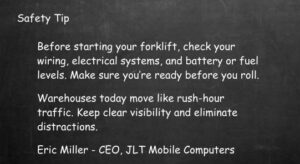
But first, as with any good warehouse huddle, let’s start with a safety tip
RFID and Smart Labels Are Moving From Pilot to Baseline
RFID isn’t experimental anymore. Tag volumes have grown from 20 billion in 2020 to projections exceeding 100 billion by 2028. That kind of scale changes expectations. If everything is readable, everything can be verified.
Peak Technologies and Zebra taught us the real unlock isn’t RFID alone. As Tony Rivers explained, combining RFID, machine vision, and barcode systems lets operators “solve for things that you couldn’t have solved for five years ago.” That visibility stretches from store shelves to dock doors to pallet wrap stations.
And increasingly, it’s automatic. “We’re capturing that data automatically,” Matt Ploude said. In fact, “Machine vision is leading the way.”
Sonaria pushed the conversation further. As Wirthlin explains, RFID in warehousing only works if it aligns with how work already happens. “Good RFID, when done right and done efficiently, it removes steps.” The goal isn’t more scanning. It’s less friction. That’s why Sonaria designs interfaces that are “Fisher-Price simple and sausage finger friendly.”
Then came smart labels.
Reelables described continuous tracking as “like doing a full warehouse stock check every minute.” Bluetooth reads over 200 meters. Cellular removes infrastructure entirely. Costs that once exceeded $100 per unit are trending toward $10 per unit.
3PLs Are Being Forced to Level Up
February also exposed the pressure on 3PL operators.
Handled called out the chaos in the post-purchase layer. Brands running 15 apps. Separate tools for support, returns, and marketplaces. “Everyone is constantly just switching between systems to try to piece together what’s going on.”
When customers escalate, the 3PL absorbs the friction.
RedSky saw a different disruption during Brexit. “I don’t think anyone understood how massive that was,” Byrne said. Overnight, customs and tariffs reshaped workflows. At times, it felt like operators were simply wishing they could “just get a DHL label.”
The response wasn’t panic. It was system maturity. Dashboards. Inventory access. Control. Modern 3PLs aren’t just moving boxes. They’re stabilizing complexity.
The Real Bottlenecks Are Structural
While visibility tools are accelerating, February made something else clear:
Sometimes the hardest problems aren’t technological. They’re structural. Sitex Group highlighted how older buildings often lack the electrical capacity needed for automation. Retrofitting “is very expensive and it takes a long time.” In some cases, it can take six to twelve months just for utility approvals.
Meanwhile, Terminal Industries argued that “the yard is probably the most under-modernized node in the supply chain.” Digitizing arrival data, damage detection, and dock scheduling can unlock 10–20% more value from existing WMS investments — often within 12 months.
Assembled Products tackled a different structural constraint: software alignment. Instead of heavily customizing off-the-shelf systems, Meyer and his team built their own WMS. “The effort to customize just seemed like a lot to take on,” he explained. The priority was simple: “We wanted something where the system knows at all times what’s on every pallet.” Just as important, “We were very, very close to the people who would use it every day.”
Even inside the four walls, discipline matters. Essilor Luxottica doesn’t chase hype. “We do a small pilot, and we start small.” Every deployment includes a recovery plan.
And ATOMIX brought it back to culture: “If you have the right culture and you’re empowered, it really is just trying to fix a big puzzle every day.” Over time, “people are hunting for the inefficiencies.”
February and Beyond with The New Warehouse
In February, The New Warehouse was on the road again as we traveled to Manifest, where conversations around software-driven robotics and data readiness reinforced how much integration now matters. We’re rolling out more from the floor in the coming weeks. DC 101 continued digging into operational alignment and leadership inside the warehouse, and we hosted a live discussion on ASRS with operators who are actually running these systems.
That’s your February huddle.
Be sure to subscribe to our YouTube channel for exclusive warehouse content, and stop by and see us in April at Modex.