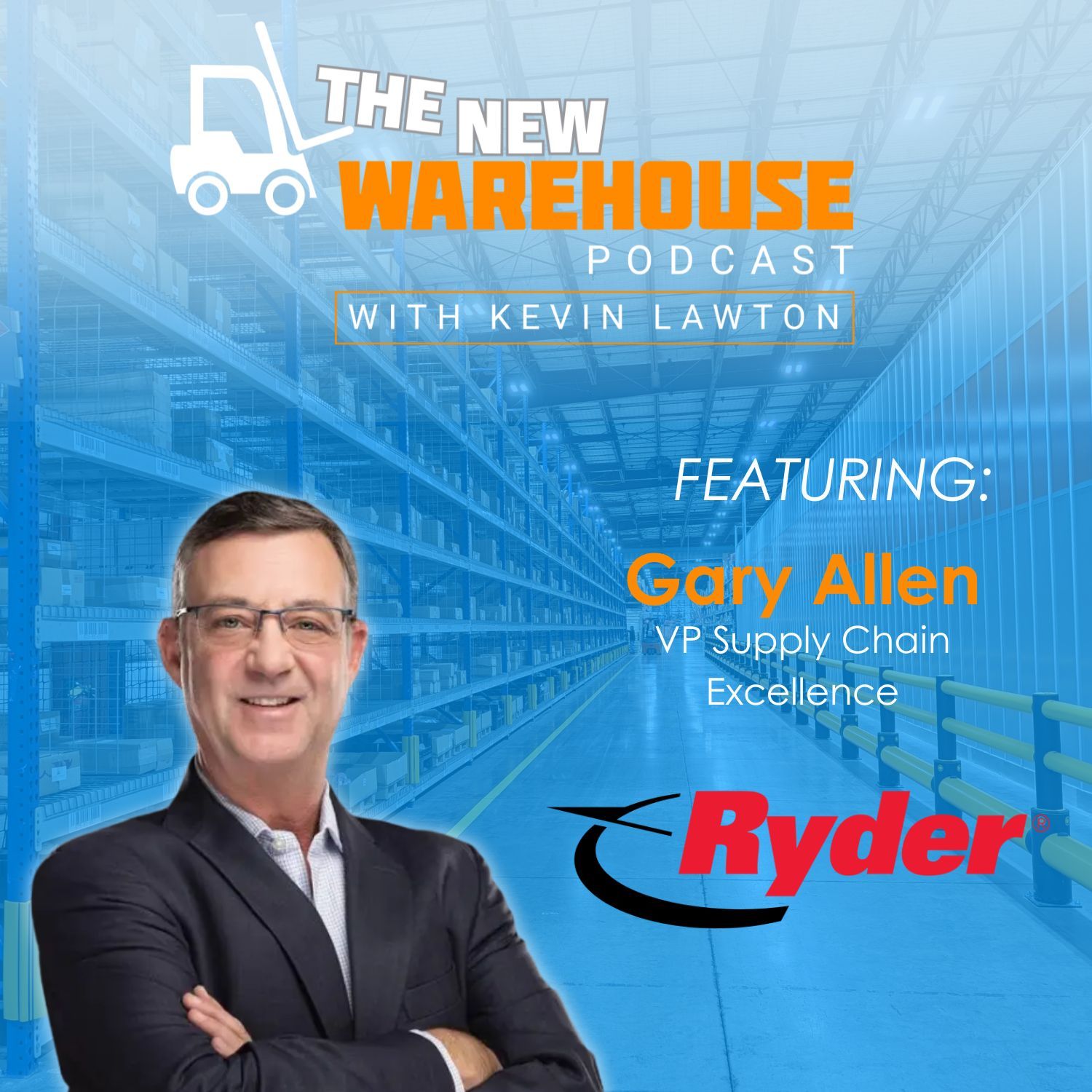
Where is Warehouse Technology Heading with Gary Allen of Ryder?
Welcome to this episode of The New Warehouse Podcast, recorded live from Manifest 2026 in Las Vegas. Kevin Lawton sits down with Gary Allen, Senior Vice President of Supply Chain Technology at Ryder, for an annual check-in on where warehouse technology is heading. Ryder, one of North America’s largest logistics providers, operates more than 100 million square feet of warehouse space and manages a vast transportation network.
In this conversation, Allen shares how warehouse automation and AI are maturing, and where real ROI is emerging. He also explains why execution is now the differentiator for operators navigating labor constraints, brownfield facilities, and rapidly evolving technologies.
Automation Is Maturing and Becoming Practical
Warehouse automation has moved well beyond pilots and experiments. Allen notes that adoption has accelerated rapidly across Ryder’s network, explaining that “about 40% of our warehouses have some form of automation today.” A decade ago, that number was closer to single digits. Autonomous mobile robots, forklifts, and AS/RS solutions are now common, driven by rising labor costs and improving technology economics.
In many cases, the hardware itself is no longer the differentiator. “If you look at autonomous mobile robots, I would say it’s a commodity,” Allen says, pointing out that performance gaps increasingly come down to software and integration rather than machines. So, where does Allen see warehouse technology heading? This shift is forcing operators to think less about buying robots and more about how automation fits operational realities, especially in space-constrained brownfield facilities. “It continues to advance to reduce travel time, then putaway, picking, autonomous loading and unloading, and then eventually humanoids.”
Everything AI as AI Moves from Theory to Operations
AI has long existed in warehousing through machine learning and analytics, but Allen emphasizes that the current shift is about execution. “AI’s been around for decades… It’s the agentic AI, the Gen AI, that’s new,” he explains. At Ryder, AI is being applied first to operational planning, particularly labor forecasting. Using internal data from WMS and labor systems, Ryder is deploying models that forecast labor needs 30 days out, weekly, and intraday. The challenge, however, is not building the model. Allen adds, “We see two main disruptive themes from a warehousing perspective: it’s warehouse automation, and it’s AI, and the two are converging.”
“The hardest part isn’t really building out the AI… the hardest part is how do you operationalize it?” Allen says. Acting on AI recommendations requires changes to shift structures, staffing models, and decision-making processes, not just better algorithms.
Reliability, Not Just Productivity, Drives ROI
As automation and AI converge, Ryder’s focus is shifting toward reliability and real-time decision support. Allen stresses that uptime matters as much as throughput, noting, “The true benefit, in our view, is not only productivity, it’s the reliability.” Today, many operations still react after systems fail.
Ryder is exploring AI agents that can guide operators during disruptions, pulling from live data, SOPs, and historical performance. “We wait for something to break, and then you do root cause,” Allen explains, outlining why that reactive model no longer scales. By combining labor, machine, and inventory data, Ryder aims to move toward proactive decision-making that supports operators on the floor, not just dashboards in the office.
Key Takeaways
- Ryder operates over 100 million square feet of warehouse space across North America.
- Approximately 40% of Ryder warehouses now use some form of automation.
- Autonomous mobile robots are increasingly commoditized; software is the differentiator.
- Agentic AI is being applied to labor forecasting and operational planning.
- Labor forecasts are built using internal WMS and labor management data.
- Operationalizing AI requires process change, not just technology.
- Reliability and uptime are emerging as core drivers of ROI for automation.
- Brownfield facilities dominate Ryder’s network, shaping automation strategies.
Listen to the episode below and leave your thoughts in the comments.
Guest Information
For more information on Ryder, click here.
To connect with Gary Allen on LinkedIn, click here.
For more information on the future of warehouse technology, check out the podcasts below.
How to Help Your Leadership Team Justify Investing in Warehouse Automation