Automation Lessons from J.P. Morgan Payments
What does J.P. Morgan have in common with warehousing? More than you might expect. Behind every check is a physical operation involving mail collection, document handling, sorting, scanning, and data processing.
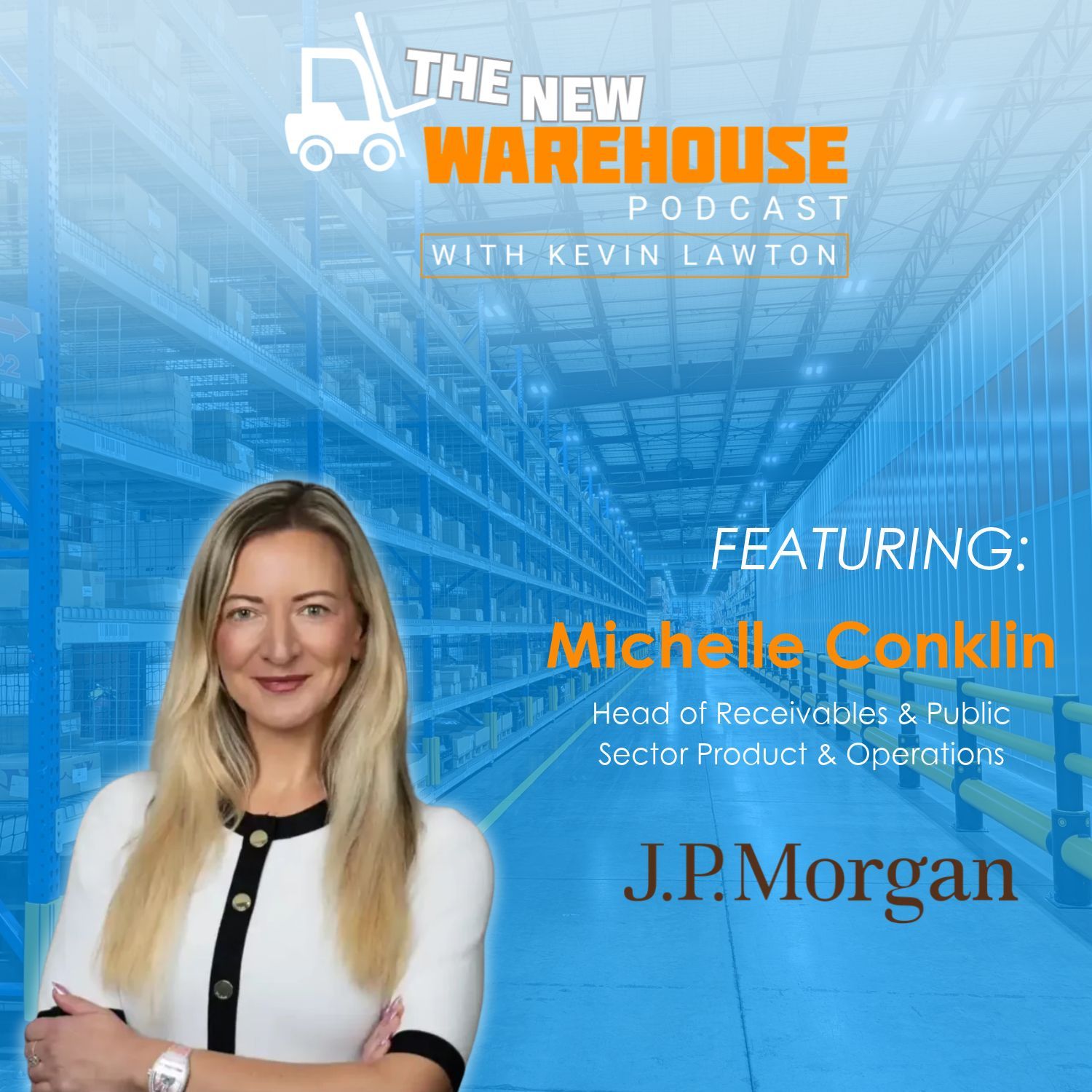
Welcome to The New Warehouse Podcast. Kevin speaks with Michelle Conklin, Head of Receivables and Public Sector at J.P. Morgan Payments, about using AI and robotics to modernize an operation handling approximately 130 million physical payments annually.
Tackling 4,000 Variations With Robotics and AI
Opening an envelope sounds simple until you try automating it. J.P. Morgan encounters more than 4,000 envelope permutations, with checks, invoices, and other documents arriving folded, stapled, or paper-clipped together. Every variation creates another challenge for a robotic system.
Conklin explains, “We treated this entire endeavor as a true operating model change. It was not about equipment and installation.”
J.P. Morgan partnered with Ripcord after struggling to find a robotics provider willing to tackle the challenge. The companies began with a prototype, then tested the equipment using actual documents. Ripcord’s team even brought 3D printers on-site to produce replacement components during development.
“So we started with a very initial prototype. We proved that it’s possible, and so then we built on top of that.”
The resulting system uses robotic arms, cameras, suction cups, and AI models to prepare and identify documents. It must even distinguish a check from an attached payment stub without physically separating them.
Keeping Automation From Creating New Bottlenecks
J.P. Morgan’s operation serves approximately 9,000 clients, each with different processing instructions. Before modernization, employees manually validated checks and entered information based on those requirements.
The company started by bringing AI specialists onto the production floor to observe employees. They studied operators’ decisions and tested whether AI could reliably extract information from documents.
Accuracy was especially important. Conklin explains, “We set thresholds at 100% confidence level,” so uncertain results were sent to employees for review. Experienced operators also helped develop the new system’s rules, interfaces, and workflows.
The challenge extended beyond individual processing steps. New technology needed to connect with existing scanning, downstream processing, and exception handling without disrupting client service.
Conklin offers a warning for any warehouse considering automation: “do not automate one task and create a new bottleneck 10 feet downstream because you’re so hyper-focused on that one task.”
That thinking shaped J.P. Morgan’s rollout, from initial discovery through live prototypes, production pilots, and controlled scaling.
Cutting Training Time From Months to Days
One of J.P. Morgan’s most notable improvements came from simplifying the employee experience. Previously, new hires spent months learning client requirements, processing procedures, and quality standards. They progressed from simple transactions to more complex work, with extensive quality checks along the way. “The learning curve was about six to nine months.” However, the new platform has changed that timeline. Employees now reach the production floor within their first week, although learning and oversight remain important.
Automation also changed how employees spend their time. J.P. Morgan previously captured approximately 13 billion keystrokes manually each year. Much of that repetitive entry has been automated. Instead, employees concentrate on checking data quality, researching exceptions, and monitoring AI performance. Their operational experience remains essential when transactions don’t follow expected patterns.
Conklin explains, “Our people understand the operation; they recognize when something is unusual and know how to respond, where a model or a robot may necessarily not know.” J.P. Morgan’s experience shows how redesigning a process can improve both productivity and the work employees perform.
Key Takeaways
- Start with operational complexity. J.P. Morgan designed automation around more than 4,000 envelope and document variations.
- Test with actual work. Prototypes and production pilots exposed problems before broader deployment.
- Protect downstream processes. Automated tasks must connect with existing workflows and exception handling.
- Preserve human judgment. Employees review uncertain AI results and manage unusual transactions.
- Simplify employee onboarding. New hires now reach the production floor within their first week, compared with a previous six-to-nine-month learning curve.
Listen to the episode below and leave your thoughts in the comments.
Guest Information
For more information on J.P. Morgan Payments, click here.
To connect with Michelle Conklin on LinkedIn, click here.
For more episodes like this one from J.P. Morgan Payments, check out the podcasts below.
Warehouse Automation Has Raised the Technical Ceiling. What About the Brownfield Floor?