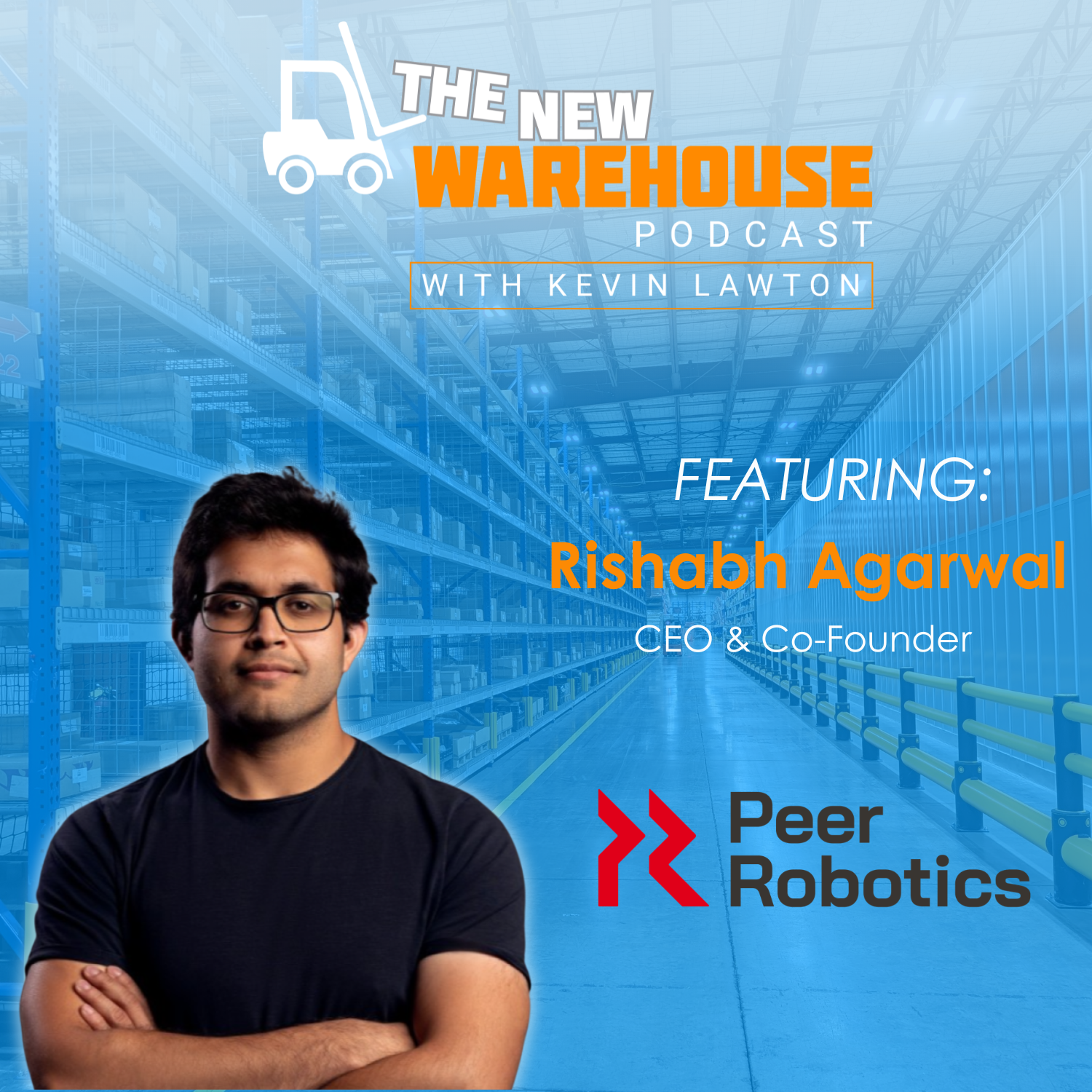
Peer Robotics: When Warehouse Robots Become Operational Peers
Peer Robotics CEO and co-founder Rishabh Agarwal is today’s guest on The New Warehouse Podcast. Peer Robotics develops collaborative mobile robots designed to automate material movement across manufacturing and warehouse environments. Its Peer 3000 platform moves pallets and supports applications including trailer loading and unloading.
In the conversation, Agarwal looks beyond what the robot can physically do. He explains why ease of use may determine automation adoption, why ROI must appear quickly, and how human-in-the-loop systems can make robotics more adaptable. He also sees robots becoming a source of operational data, not just physical labor.
Peer Robotics Believes Robots Learn Best as Operational Peers
Peer primarily focuses on pallet movement. As Agarwal explains, the Peer 3000 “ is designed in such a way that it learns from humans in real time.” The vision-based system follows the human, maps the facility, and learns pick-and-drop locations. “ We are trying to build these systems, these kind of physical intelligence platforms that can be so simple so that people on the shop floor can integrate and deploy it.”
For Agarwal, automation does not scale simply because a robot can perform the work. “I realized there’s a massive gap when it comes to how easy the technology is to use.” That matters because most warehouses do not employ robotics engineers. “The point at scale is not when it starts doing the application; it’s when it becomes easy enough that people can adopt it.”
Peer’s approach puts more control in the hands of floor operators. As Agarwal explains it, Peer Robotics operates on the principle that “The human is in control, and they are teaching the robot.” The robot keeps learning from operators’ preferred actions, getting better and better for that specific warehouse or manufacturing site.
For Warehouse Operations, Robotics Must Work Without Robotics Engineers
Agarwal’s interest in accessible automation began close to home. “I chose mechanical engineering to build machines and soon realized robots are the new machines.” But his benchmark for success is not whether Peer Robotics can automate the largest warehouse. It is whether the technology can work for smaller operations. “I think that would be a mark that we have crossed that chasm and robots are universal.”
Agarwal points out that warehouses are not designed for robotics engineers to operate from. He watched his father purchase machinery that required specialized engineers whenever the operation changed. That model becomes challenging and expensive, especially in warehouse operations where products, layouts, and workflows constantly shift.
Agarwal believes that is why many smaller operations remain hesitant about robotics. “It’s not that they’re too small for automating their operations. They’re too small for having some complex technology that they don’t know how to use.” For robotics to become universal, floor operators must be able to teach, adjust, and redeploy the technology themselves.
Robotics Can Become a Gateway to Digital Transformation
Robotics may also give warehouses a practical way to begin digitizing operations without first replacing every paper-based process. While moving a pallet from a trailer, Peer’s vision-based robot can photograph its barcodes and send that information to a WMS, ERP, local storage system, or even an Excel file. “That can be the gateway for these customers to start integrating that digital technology.”
The robot can also maintain its own record of where a pallet was picked up and stored. This gives operations access to useful inventory data while they gradually build out their larger technology infrastructure. “Physical labor is easier to automate, but then that would open up the door for a lot of digital value that these customers can get.” Agarwal sees possibilities beyond barcode capture, including pallet damage, damaged cases, and claims documentation. “The robot could literally be that connecting tool for all these digital technologies and physical automation.”
Key Takeaways from Peer Robotics
- A robot is only scalable when warehouse employees can use it without relying on robotics engineers.
- Smaller operations are not necessarily too small for automation; the technology is often too complex for them to manage.
- Allowing floor operators to teach robots makes automation easier to adapt as workflows change.
- Robots can collect barcode and inventory data while moving pallets, giving warehouses a practical starting point for digital transformation.
- The real opportunity is for robots to connect physical work with inventory visibility, damage detection, and claims documentation.
Listen to the episode below and leave your thoughts in the comments.
Guest Information
For more information on Peer Robotics, click here.
To connect with Rishabh Agarwal on LinkedIn, click here.
For more solutions like Peer Robotics, check out the podcasts below.
Retina Robotics Brings Computer Vision to Warehousing
Mixed Case Palletizing: Jacobi Robotics and the Holy Grail
636: Robotics, Software, and the Future of Humanoids in Warehousing