Warehouse Automation Strategy Starts with Software
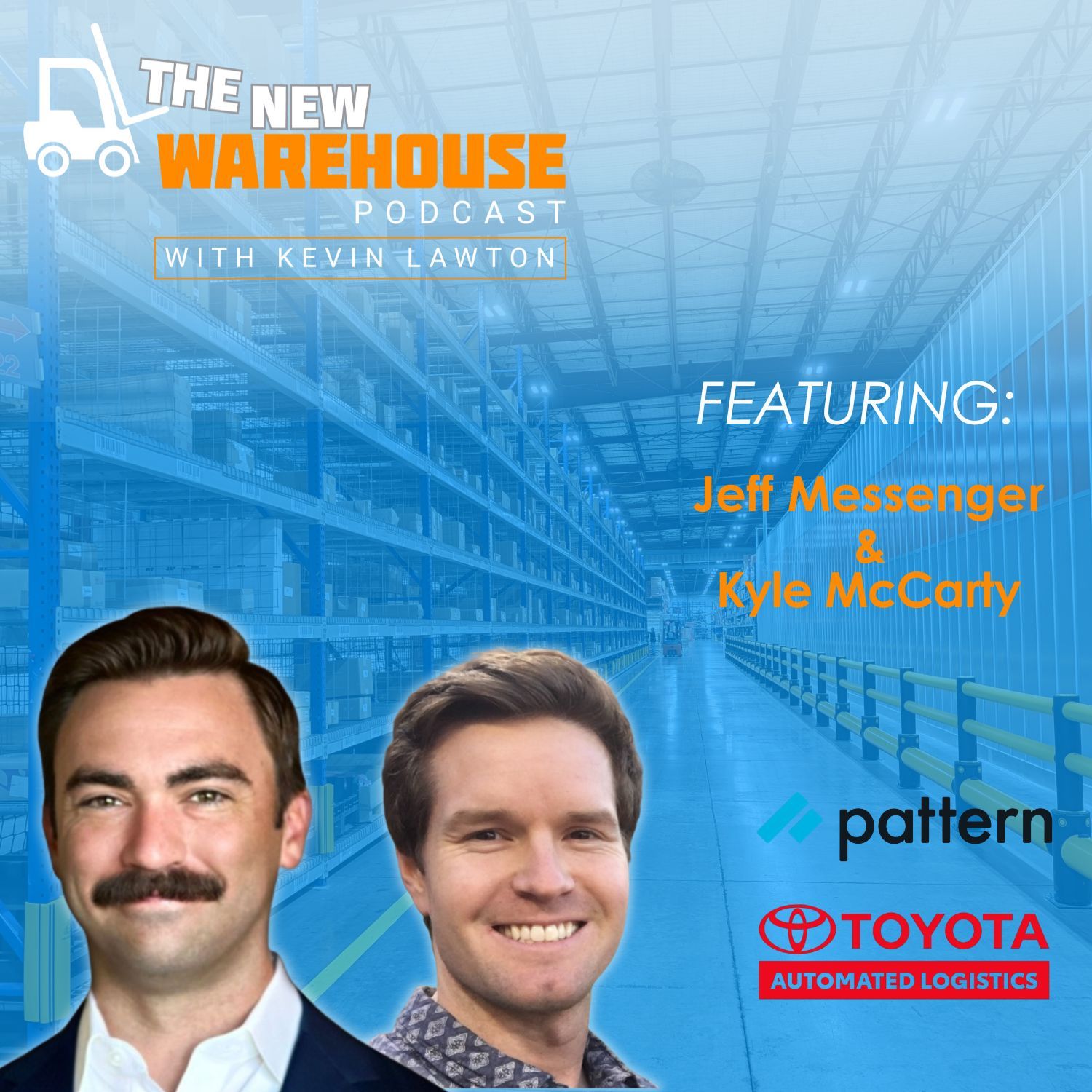
Welcome to this episode of The New Warehouse Podcast. In this episode, we welcome two guests. Kyle McCarty, Sr. Field Application Engineer at Toyota Automated Logistics, and Jeff Messenger, VP of Reverse Logistics and Facilities/Maintenance/Eng at Pattern. Both companies are at the absolute forefront of transforming material handling and supply chain logistics. Today, we dive into how modular frameworks, virtual testing, and a software-first approach. The discussion highlights how operations of all sizes can scale efficiently, minimize implementation risks, and successfully optimize their workflows before making major capital investments.
Warehouse Automation Strategy, Not Shiny Objects
Warehouse automation is no longer a luxury reserved only for massive corporate enterprises. Accessibility has expanded dramatically across the industry, but physical hardware alone is no longer the true differentiator. The next wave of industry innovation is being driven entirely by intelligent, highly adaptable software frameworks. Smaller, targeted footprints are now emerging as the absolute best operational fit for small to medium businesses.
Messenger explains that automation should never become a distraction from operational excellence. “I think we leverage our experience pretty effectively to not just chase shiny objects or new tech when it hits the market or gets exciting.” Instead, the focus remains on long-term reliability, maintainability, and operational flexibility. He also notes, “Designing in reliability from the start is definitely a big theme.”
Toyota Automated Logistics complements that philosophy through collaborative design. As McCarty explains, “Ultimately, we want something that will be there for the long term to help the business grow.” Rather than selling technology, the team works to understand business goals before recommending automation solutions.
Collaboration Unlocks Better Automation Solutions
Messenger credits that collaboration for uncovering options his team didn’t know existed. “Something not a single one of us at Pattern were aware of were shoe sorters that were bi-directional.” He added, “It really unlocked our ability to be a true, closed-loop, end-to-end cross-dock if we wanted to.”
McCarty emphasized that strong relationships make those discoveries possible. “You need to do a ton of relationship building and understanding and really get into the meat of your operations and the long-term view.” Additionally, he stresses the value of working directly with customers: “Those in-person meetings are invaluable.” McCarty adds, “You can learn more in an hour on site than you can in ten virtual meetings.” Those conversations ultimately produce automation designed for today’s operations and tomorrow’s growth.
The Future of Automation Is Flexible and Software-Driven
Both guests agreed that warehouse automation is becoming more accessible, but smarter software will drive the next wave of innovation. Modular technologies, AI, simulations, and workflow automation will allow companies to improve operations before making major capital investments.
McCarty sees flexibility becoming the defining trend. “I think that flexibility, with modular solutions, is really the name of the game for the future.” He also noted that automation is becoming attainable for more organizations as “you’re now seeing a lot more, smaller solutions that are gonna be best fit for small to medium businesses.”
Messenger believes software should always come first. “To think about automating the software and the workflows first and the hardware second or last.” He reinforced that philosophy with a simple rule: “The last step you should take is to bolt something down to the ground. Bolting things to the concrete comes with a lot of trade-offs.” By automating workflows first, companies gain flexibility while allowing hardware investments to support proven operational improvements.
Key Takeaways
- Design an automation framework around immediate business requirements and long-term scaling constraints.
- Build deep partnerships between operators and automation vendors; direct on-site discovery is irreplaceable.
- Map, simulate, and finalize your software architecture and workflows completely before selecting physical hardware.
- Utilize simulation and virtual testing tools to validate configurations before investing capital.
- Focus on flexible, scalable solutions; smaller, modular systems are highly effective for medium-sized operations.
Listen to the episode below and leave your thoughts in the comments.
Guest Information
For more information on Pattern, click here.
For more information on Toyota Automated Logistics, click here.
To connect with Jeff Messenger on LinkedIn, click here.
To connect with Kyle McCarty on LinkedIn, click here.
For more information about warehouse automation strategy, check out the podcasts below.
Interact Analysis: Inside the 2026 Warehouse Automation Market
Warehouse Fulfillment Strategy for a Changing Consumer Landscape
eCommerce Fulfillment Strategy: What Growing Brands Must Get Right

Warehouse Automation: Insights from Michael Erhard of Amazon
[…] Warehouse Automation Strategy Starts with Software […]
Toyota Material Handling: Insights from CEO Brett Wood
[…] Warehouse Automation Strategy Starts with Software […]