Warehouse Real Estate Market Finding Balance
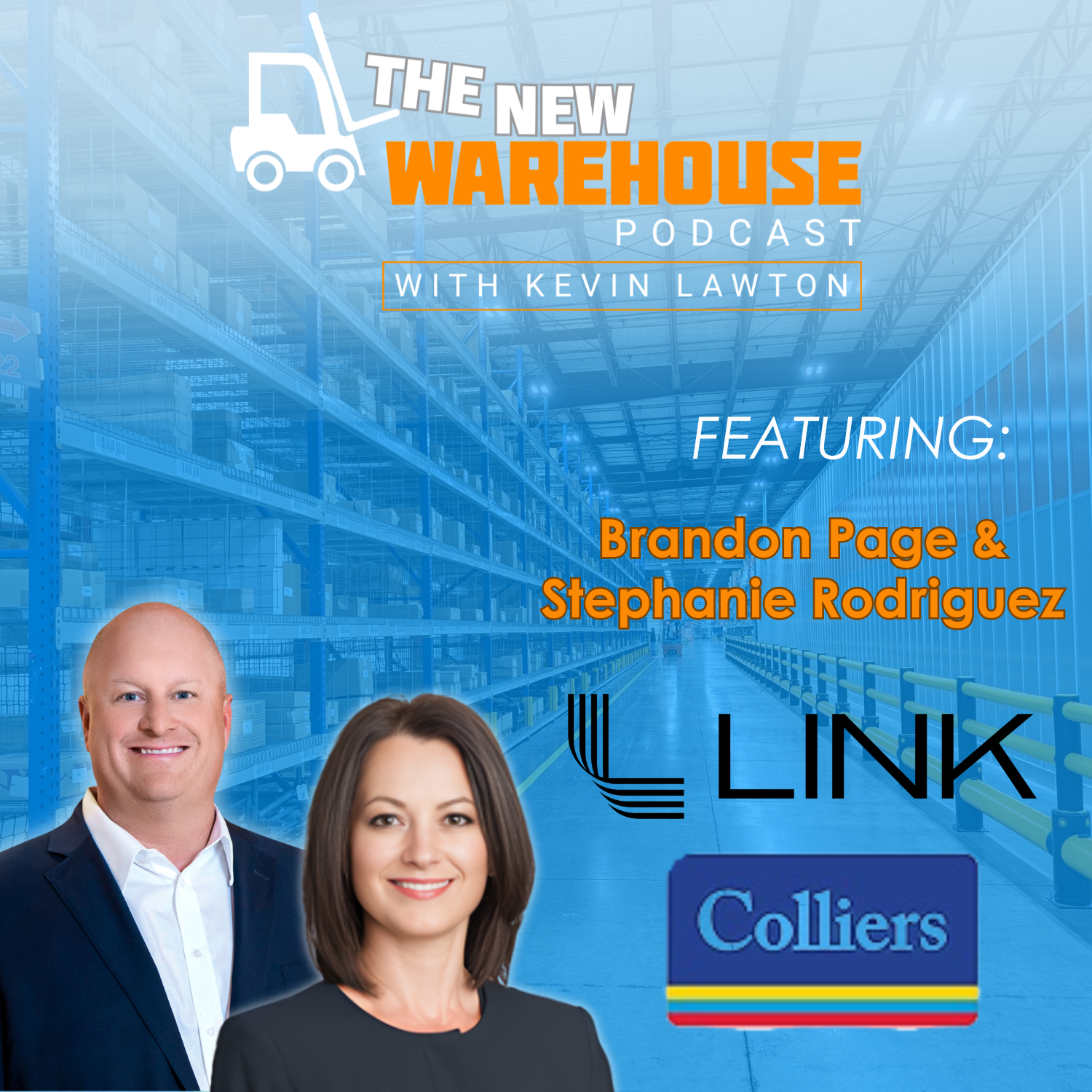
In this episode of The New Warehouse Podcast, Kevin chats with Brandon Page, Executive Vice President and Head of Leasing and Customer Solutions at Link Logistics, and Stephanie Rodriguez, National Director of Industrial Services at Colliers. Together, they break down how the warehouse real estate market is shifting into a more balanced state.
Link Logistics, with roughly 3,000 buildings and 470 million square feet, represents a massive footprint across the U.S., while Colliers brings a global advisory perspective. The conversation explores changing demand patterns, evolving decision-making, and what warehouse operators need to understand as they evaluate space in today’s market.
The Warehouse Real Estate Market Shift
Once defined by extreme demand or oversupply, the warehouse real estate market is settling into a more stable and competitive environment. As Brandon explains, “the first word that comes to mind, I think, is balanced.” Vacancy rates now average around 7–8% nationally, giving tenants more options while still maintaining activity for landlords.
However, balance doesn’t mean ease. Brandon notes that “it doesn’t feel great, which suggests that it’s certainly not as landlord-friendly as it was during COVID.” This shift reflects a broader normalization after years of unprecedented demand. Tenants now have leverage, and landlords must compete more aggressively on pricing and concessions.
At the same time, demand has not disappeared. Instead, it has slowed in execution. Larger deals, especially those above 250,000 square feet, have lagged, while smaller, last-mile spaces remain active. This “tale of two markets” highlights how operators are adjusting strategies rather than stepping away entirely.
Why Demand Paused, Not Disappeared
Uncertainty is largely to blame for the slowdown in large-scale leasing. Stephanie points out that “there was such tremendous activity in industrial real estate 2020 into, you know, 2023,” followed by a surge in construction that flooded the market with new space.
As that supply hit, demand stabilized. Tenants became more cautious, especially when committing to large footprints. Stephanie explains, “Tenants didn’t wanna make those big bets.” Instead of locking into long-term, high-cost leases, many operators chose smaller spaces or delayed decisions altogether.
Companies are taking longer to evaluate risk, often involving more stakeholders. With C-suite leaders now heavily involved, decision timelines have stretched. This added scrutiny has slowed deals, even as operational needs continue to grow. The result is a market where activity exists, but execution requires more effort, more data, and more confidence than before.
The New Decision Drivers for the Warehouse Real Estate Market
While location has always been critical, the factors driving site selection are evolving. Stephanie highlights that “power availability is huge.” As automation, robotics, and AI adoption increase, power infrastructure has become a top priority for tenants planning long-term operations.
Labor competition is intensifying across the warehouse real estate market, especially in dense industrial hubs where facilities cluster together. As Stephanie Rodriguez explains, “the labor market is very competitive, especially in some of these locations where we see, bulk building after bulk building, they are all fighting for the same workers.” To stand out, many operators are investing in on-site amenities and more engaging work environments to retain and attract talent.
Location continues to play a dominant role, especially for last-mile operations. As Brandon puts it, “the old location, location, location still rings through.” Proximity to customers can outweigh even the most advanced building features. “The Sunbelt is definitely an area that’s seeing tremendous growth with tremendous demand.” That momentum is being reinforced by nearshoring & reshoring, population growth, rising consumption, and the broader economic tailwinds shaping markets like Dallas, Atlanta, and Phoenix.
Key Takeaways
- The industrial market is stabilizing with vacancy rates around 7–8%.
- Large leases (250,000+ sq ft) slowed, while smaller spaces remain active.
- Post-pandemic construction created a temporary oversupply of space.
- Power availability is now a top site selection factor for tenants.
- Roughly 70% of demand in 2025 targeted modern big-box facilities.
- Link Logistics operates ~3,000 buildings and 470 million sq ft.
- Nearly 5% of U.S. GDP moves through Link’s facilities.
- 3PLs are re-entering the market as excess “shadow space” declines.
Listen to the episode below and leave your thoughts in the comments.
Guest Information
For more information on Colliers, click here.
For more information on Link Logistics, click here.
To connect with Stephanie Rodriguez on LinkedIn, click here.
To connect with Brandon Page on LinkedIn, click here.
For more information about the warehouse real estate market, check out the podcasts below.
Industrial Real Estate Trends: Forces Reshaping Warehousing Today
December 2025 Warehouse Trends: Real Estate, Execution, and Problem-Solving