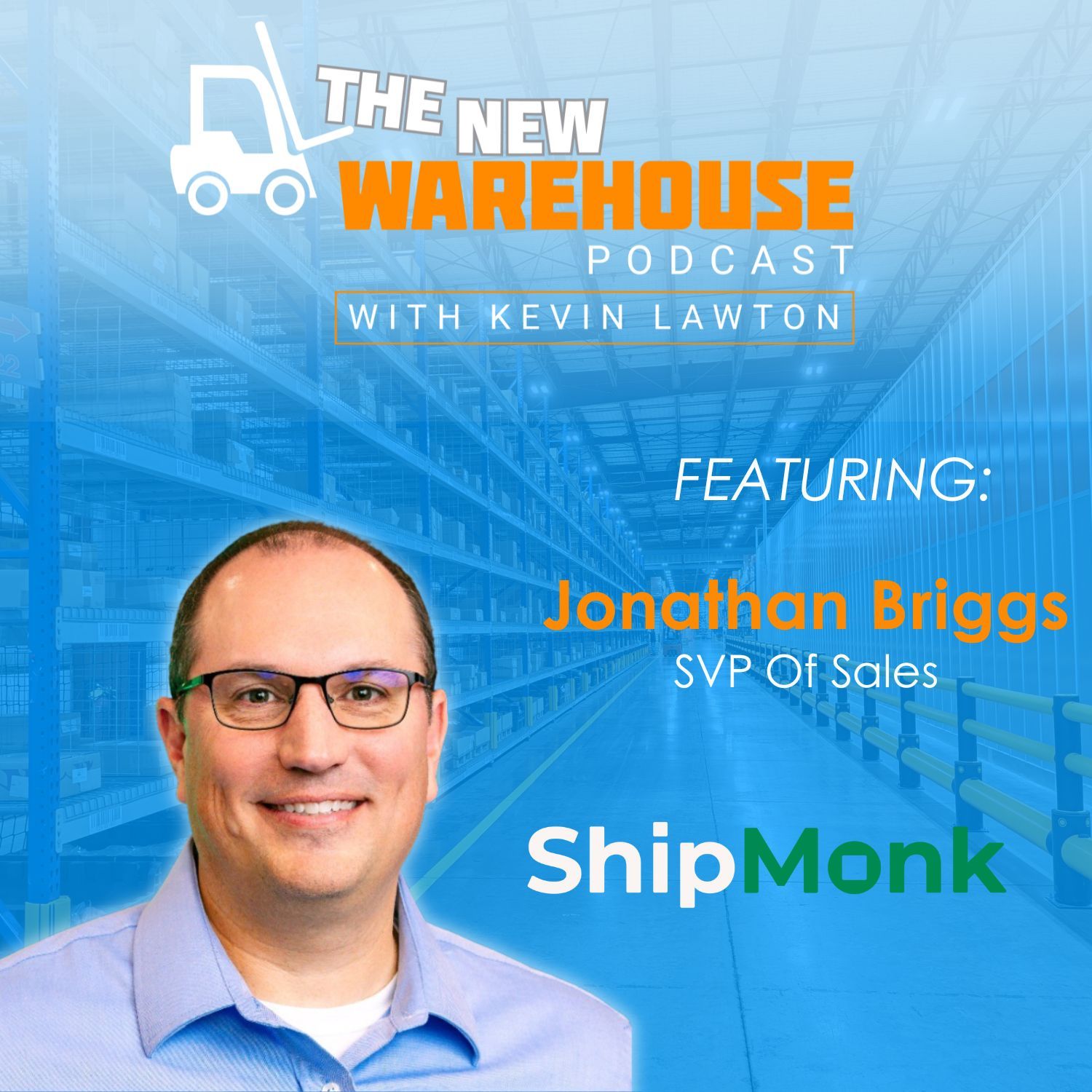
eCommerce Fulfillment Strategy: What Growing Brands Must Get Right
In this episode of The New Warehouse Podcast, Kevin Lawton welcomes Jonathan Briggs, Senior Vice President of Sales at ShipMonk. With peak season just behind them, Briggs shares insight into how ShipMonk has matured over the past decade, what brands misunderstand about automation, and why fulfillment has become a defining factor in long-term growth.
From technology decisions to carrier performance and global expansion, the conversation shows how fulfillment is evolving. Today, an eCommerce fulfillment strategy is no longer a back-end function; it’s a competitive advantage when executed correctly.
Fulfillment Has Outgrown the One-Channel Model
As brands scale, fulfillment complexity grows quickly, often faster than expected. Briggs explains that many companies still operate as if fulfillment is a simple extension of order processing, when in reality it has become a multi-layered operation tied closely to growth, customer experience, and profitability. “There’s no such thing as a single-channel customer here in 2025 rolling into 2026,” he explains, noting that most brands now operate across multiple platforms, integrations, and sales channels. That shift has forced fulfillment providers to evolve as well. ShipMonk’s own transformation reflects this change.
“We grew up and matured a ton, and we forgot to tell the market about it,” Briggs says, describing how the company has expanded from simple fulfillment into complex, high-volume, multi-SKU operations. Today, that evolution includes personalization, customized packouts, and sophisticated system integrations designed to support scale without sacrificing accuracy or speed.
Why Automation Isn’t the Answer Everyone Thinks It Is
While automation continues to dominate industry conversations, Briggs cautions that most investments fail because they don’t align with operational reality. In shared fulfillment environments, automation must serve every customer, not just a few. “If I invest in automation and it doesn’t help every customer, all I did was raise their cost,” he explains. That challenge becomes even more pronounced when companies chase high-dollar automation without fully understanding its limitations.
“You can’t just bolt down tens of millions of dollars of CapEx and hope it works,” Briggs says, pointing to high-profile failures where automation promised efficiency but delivered inflexibility. Instead, ShipMonk has focused on practical improvements like software optimization, intelligent product placement, and packaging efficiency. These changes reduce labor, improve accuracy, and scale without locking brands into rigid systems that can’t adapt as demand changes.
How the Right Fulfillment Strategy Drives Growth
According to Briggs, fulfillment becomes a competitive advantage when it removes friction rather than creating it. Brands that succeed are the ones that no longer have to manage fulfillment daily because the system works reliably in the background. “If you don’t have your supply chain solved, you don’t get that valuation,” he explains, pointing to how strong fulfillment directly supports brand growth and acquisition readiness. That stability allows brands to focus on marketing, product development, and customer acquisition instead of operational firefighting.
From monitoring shipping carrier performance to preventing billing errors and optimizing packaging, ShipMonk’s approach centers on protecting margins while improving speed and reliability. The result is a fulfillment operation that supports scale instead of slowing it down.
Key Takeaways
- eCommerce fulfillment has become significantly more complex as brands scale across channels.
- Automation only delivers value when it supports flexibility and real operational needs.
- High-capex robotics often fail due to long ROI timelines and limited adaptability.
- Visibility into carrier performance and fulfillment data is critical.
- Strong fulfillment strategy directly impacts growth, valuation, and scalability.
- The best fulfillment partners remove friction rather than adding oversight.
Listen to the episode below and leave your thoughts in the comments.
Guest Information
For more information on ShipMonk, click here.
To connect with Jonathan Briggs on LinkedIn, click here.
Looking to develop your eCommerce fulfillment strategy? Check out the podcasts below.
Connecting Warehouse Systems With Trackstar
623: Building Purpose-Driven Fulfillment with Ecomspaces
Amazon FBA Prep Services: A High-Velocity Approach from ZonPrep

Protecting Margins in Fulfillment with River Plate » The New Warehouse
[…] eCommerce Fulfillment Strategy: What Growing Brands Must Get Right […]
3PL Profitability: Smarter Shipping & Packaging Protects Margin
[…] eCommerce Fulfillment Strategy: What Growing Brands Must Get Right […]