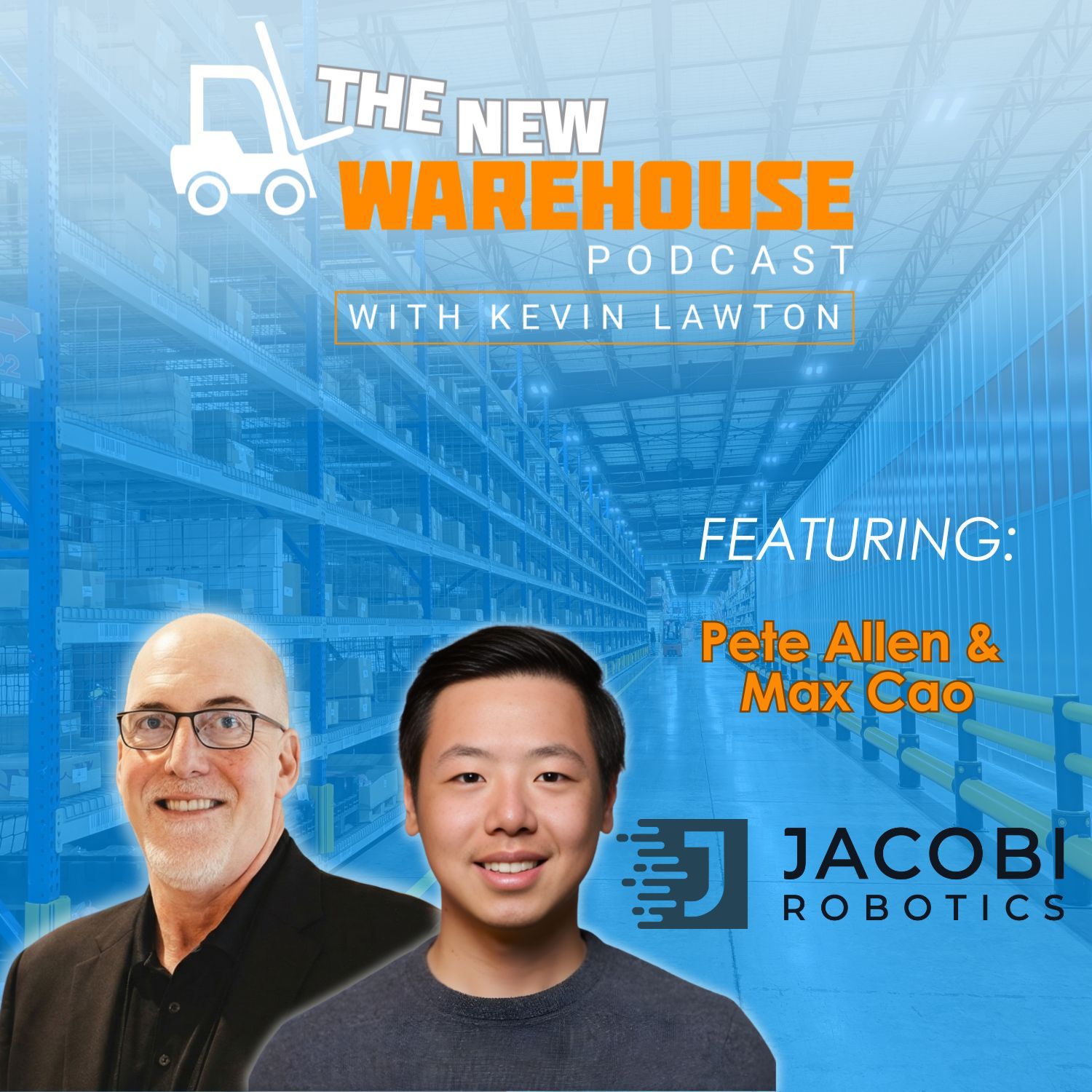
Mixed Case Palletizing: Jacobi Robotics and the Holy Grail
Kevin chats with Max Cao, Co-founder and CEO of Jacobi Robotics, and Pete Allen, who wears many hats, including serving as a Board Adviser for Jacobi. Together, they discuss long-standing challenges of tackling mixed-case palletizing in warehouse operations.
Jacobi Robotics enables robots to handle complex, real-world case flows without requiring massive infrastructure changes. The conversation explores how Jacobi is bridging the gap between research and real deployment, why brownfield environments matter, and how their Omni Palletizer is making automation more accessible across industries.
Why Mixed Case Palletizing Has Been So Difficult
Mixed case palletizing has challenged the industry for decades. Many solutions rely on heavy infrastructure and perfect sequencing upstream. That approach works in controlled environments, but not in most warehouses. As Max explains, “We observed that the gap between what was possible in a research setting and what was commercially deployed in a warehouse is quite enormous.”
Instead of imposing ideal conditions, Jacobi examined real operations. Warehouses deal with randomness every day. Pete highlights this shift clearly, noting “when boxes are coming down the line, when you haven’t sequenced them upstream, you’ll see a variety of case flows.” This includes imperfect, random, and highly variable flows.
That complexity is why the problem remained unsolved. Traditional systems require sequencing, large footprints, and major investment. Most operators simply cannot justify it. Jacobi’s approach flips that model. They built software that adapts to the chaos instead of eliminating it. Max shares how Jacobi tackles this challenge. “We’re not asking the warehouse to behave like a lab. The lab has to fit around the warehouse.”
Bringing AI Into Real Warehouse Operations
Rooted in physical AI, Jacobi’s solution predicts actions. It learns how to place cases in real time based on experience. As Max puts it, “physical AI will try to predict the next sort of physical action.”
They train the system using millions of real-world data points. That includes case dimensions, weights, and actual order flows. Over time, it builds a general stacking model that continues to improve. Max explains the impact simply: “It gets better over time just as a person would.”
This learning capability allows the system to handle unpredictable environments. It can adapt to new SKUs, changing demand patterns, and different customer profiles. Instead of rigid programming, the system evolves. For years, this challenge has been out of reach, as “it’s been called the holy Grail of warehouse automation.”
Making Automation Work in Brownfield Environments
Most warehouses are complex, constrained, and constantly running. That reality shaped Jacobi’s entire strategy. As Max explains, “Brownfield is the majority of the market.” Max explains the brownfield constraint on automation projects, stating, “You cannot shut down these operations for six to 18 months.”
Jacobi addresses this by designing modular robotic cells and simulations. The team builds a digital twin using real customer data to predict performance.
The result is a robot that behaves more like an experienced operator, fully capable of building dense, stable pallets even when the input data is inconsistent. And that’s where the real breakthrough shows up in practice. As Pete Allen explains, “if you could have a low-cost solution with a great ROI that could be just put into a Brownfield… boy, you got something.”
Key Takeaways on Mixed Case Paletizing
- Mixed case palletizing has been considered the “holy grail” of warehouse automation for over 20 years.
- Traditional solutions rely on sequencing and large ASRS systems, limiting adoption.
- Jacobi’s approach handles imperfect and fully random case flows in real operations.
- The system is trained on millions of real-world data points from warehouse environments.
- AI continuously improves performance through learning and adaptation.
- Brownfield warehouses represent the majority of automation opportunities.
- Deployment timelines have been reduced from months to just a few weeks.
Listen to the episode below and leave your thoughts in the comments.
Guest Information
For more information on Jacobi Robotics, click here.
To connect with Max Cao on LinkedIn, click here.
To connect with Pete Allen on LinkedIn, click here.
For more information about mixed-case palletizing, check out the podcasts below.
Trailer Loading with Modular Simplicity from Slip Robotics
How Roboteon Simplifies Robotic Integration for Warehouses
Cut Trailer Unload Time in Half with ErgoRider: Live From PROMAT 2025 with Caljan