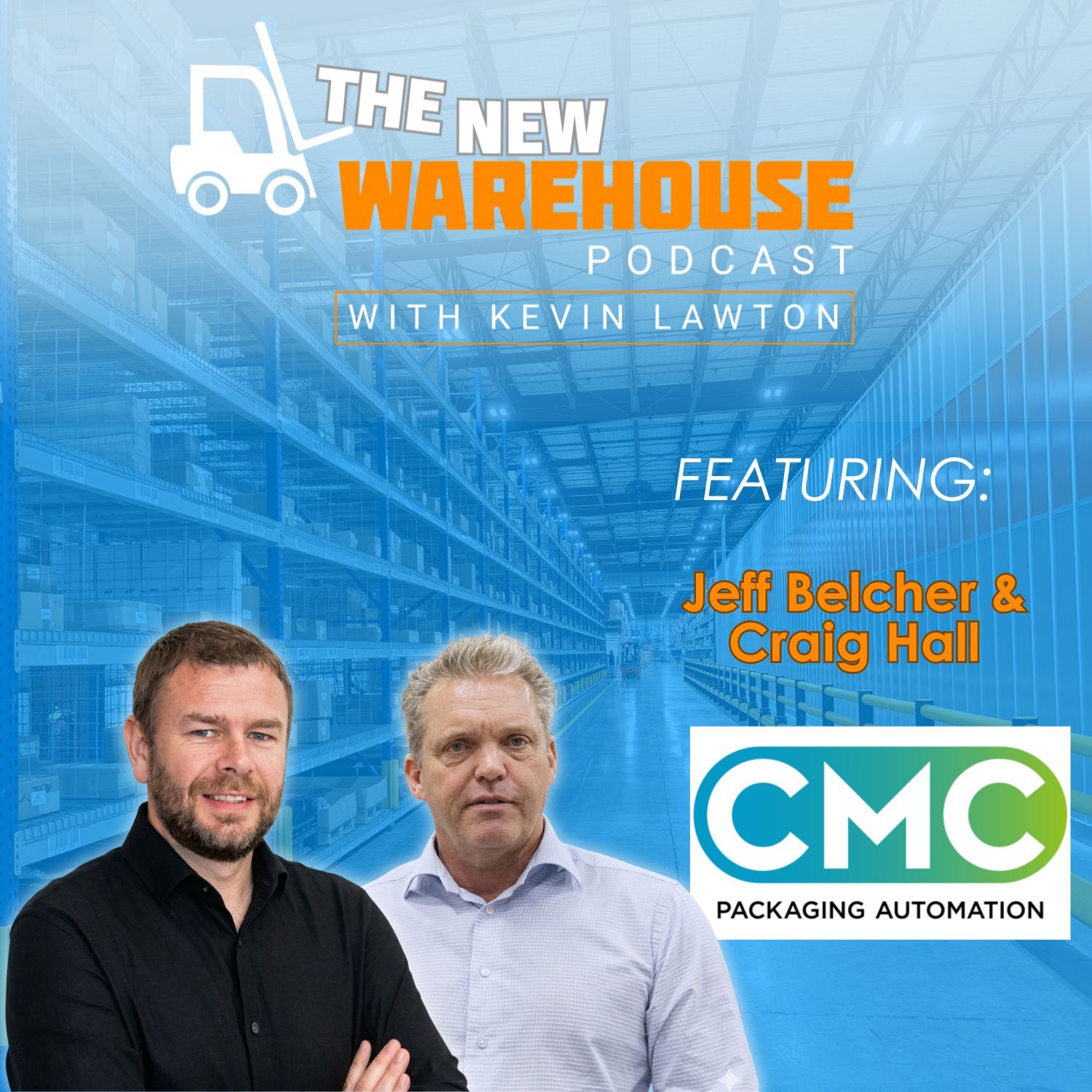
Right-Sized Packaging: A Box Last Approach Means Lower Costs & Less Waste
In this episode of The New Warehouse Podcast, Kevin chats with Jeff Belcher, General Manager at CMC Packaging Automation, and Craig Hall, Head of Sales for North America. Together, they explore how right-sized packaging automation is reshaping fulfillment operations.
CMC, a family-run company with over 40 years of history, has evolved from mailing and wrapping to become a leader in automated e-commerce packaging. The conversation focuses on the shift from manual pack stations to machine-level packaging, the rise of right-sized solutions, and how operators can rethink packout to improve efficiency, reduce waste, and better handle the complexity of modern orders.
From One-Size Boxes to Dynamic Packaging
E-commerce has changed what packaging needs to do. Orders are no longer predictable, and operations must adapt in real time. As Craig explains, “it’s no longer one size fits all.” This shift has pushed companies toward systems that can create packaging on demand rather than relying on pre-set box sizes.
Right-sized packaging automation addresses this by building the box around the product at the moment of packout. Instead of selecting from a limited set of boxes, the system determines dimensions via a cube scan and produces an exact fit. That reduces void fill and improves cube utilization across shipments.
Craig reinforces the core principle behind this approach, noting “every box that you’re going to make, or every bag that you are potentially making needs to be a different size.” The result is fewer shipments, better truck utilization, and lower environmental impact.
Moving Packaging to the Machine Level
Traditional pack stations rely heavily on labor. Workers select boxes, pack items, and manually apply labels. Right-sized packaging flips that model by pushing those decisions and actions into the machine itself.
CMC’s “box last” approach removes dependency on upstream data accuracy. Instead of relying on item master data, the system captures dimensions in real time and builds the packaging accordingly. As Jeff explains, “everything is being done at the machine level,” which simplifies integration and reduces complexity.
This shift also changes how labor is used. Rather than focusing on repetitive packing tasks, teams can be reassigned to higher-value activities. The packaging machines handle sizing, cutting, labeling, and sealing in one continuous flow.
However, automation introduces a new operational reality. Speed is only valuable when you can feed the system consistently. Craig highlights this clearly: “The question is, can I pick it that quickly and can I feed it that quickly?” That balance between upstream flow and downstream automation becomes critical.
Designing for Real-World Operations
Implementing right-sized packaging is not just about installing a machine. It requires rethinking flow, space, and throughput across the operation. Many facilities transition gradually, keeping some manual pack stations for overflow and peak demand.
The biggest driver behind adoption is labor. Peak seasons require large temporary workforces, and competition for labor is intense. Automation helps stabilize operations and reduce reliance on seasonal hiring.
CMC’s approach also emphasizes flexibility. Their systems can be configured based on customer needs rather than forcing a standard setup. Craig points out that customization is often the deciding factor, saying “it’s what happens after the, but that I would say is where CMC probably differentiates itself.”
At the same time, there are common misconceptions. Some operators assume complex integrations or restrictive consumable models. In reality, the systems are designed to integrate simply and allow customers flexibility in sourcing materials. As Jeff puts it, “it’s a dumb machine. It will do what you tell it to do.”
Key Takeaways on Right-Sized Packaging
- Right-sized packaging automation enables dynamic box creation based on real-time dimensions rather than fixed sizes.
- E-commerce growth and multi-item orders are driving the need for more flexible packaging solutions.
- Systems can run at speeds of up to 3,000 packages per hour, requiring consistent upstream feeding.
- Cube scanning removes reliance on inaccurate item master data and improves packaging accuracy.
- Machine-level packaging reduces labor dependency and reallocates workers to higher-value tasks.
Listen to the episode below and leave your thoughts in the comments.
Guest Information
For more information on CMC Packaging Automation, click here.
To connect with Jeff Belcher on LinkedIn, click here.
To connect with Craig Hall on LinkedIn, click here.
CMC Packaging Automation will showcase its latest right-sized packaging innovations, including the new Super Vertical Box and Pick2Pack solution, at MODEX 2026. Be sure to visit their booth to see these systems in action.
For more information about right-sized packaging automation, check out the podcasts below.
Smart Packaging Strategies with Shelly Nirvelli of DHL
MHI Industry Group Series: Warehouse Sustainability Through Automation