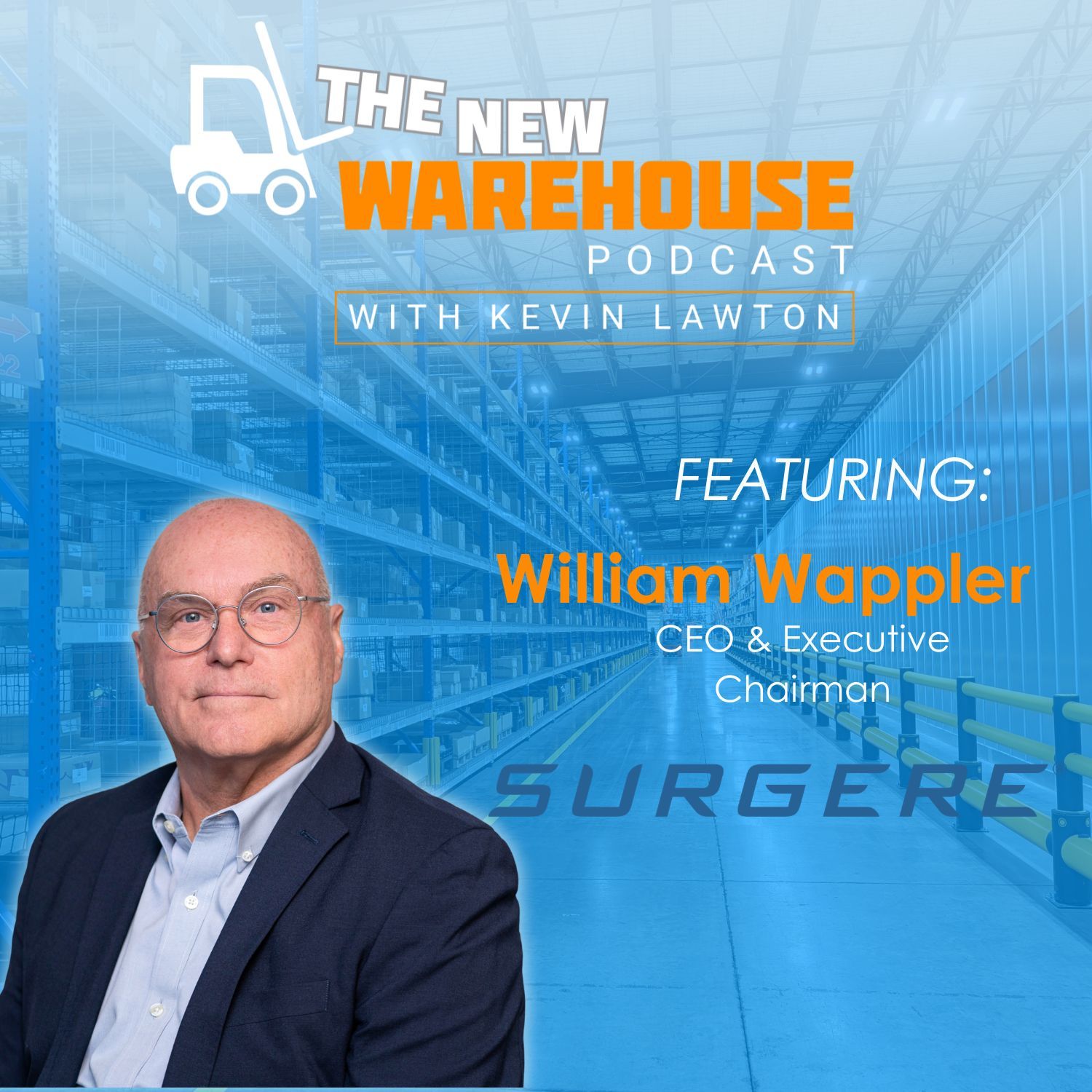
Supply Chain Data Capture Is Entering a New Era with Surgere
In this episode of The New Warehouse Podcast, Kevin Lawton speaks with Bill Wappler, CEO and founder of Surgere, live from the show floor at Manifest 2026. Surgere focuses on capturing highly accurate supply chain data and making it usable across complex logistics environments.
In the conversation, Wappler shares how data-capture technologies are evolving, how massive volumes of supply chain data are reshaping the industry, and why the next frontier may involve mobile data-capture systems and AI-driven analysis.
Supply Chain Data Capture Is the Foundation of Modern Logistics
As warehouse and logistics technologies continue to mature, supply chain data capture has become the backbone of modern operations. Automation, robotics, and advanced analytics all depend on reliable data flowing through the system. Without that data, even the most advanced technologies struggle to deliver real operational value.
Wappler explains that Surgere’s role in the industry remains surprisingly straightforward despite the complexity behind the scenes. “All we do is capture incredibly accurate data. Yeah. And share it.” The concept may sound simple, but delivering highly accurate data at scale requires sophisticated infrastructure and technology.
Accurate data is now essential for companies operating in increasingly complex supply chains. Wappler notes that organizations need reliable information simply to function effectively in today’s environment. “People really need a lot of accurate data nowadays to exist in the modern supply chain; that’s what we do. We provide the data.”
At the same time, the technologies used to capture that data are rapidly improving. Sensors, tracking systems, and digital infrastructure are becoming more capable and easier to deploy across supply chain networks.
Managing Massive Volumes of Supply Chain Data
Capturing data is only the first step. As organizations deploy more technology across their operations, the volume of data generated has grown exponentially. That scale introduces a new challenge: making the data usable.
Surgere’s platform now processes enormous volumes of information generated across supply chains. Wappler highlights the magnitude of that growth, explaining that “We are doing today about 15 billion transactions a month for our clients.”
At that level, the challenge is no longer simply gathering data. Instead, organizations must find ways to analyze it quickly enough to make decisions. When the data becomes too large or complex, companies risk falling behind operationally.
This is where artificial intelligence begins to play a critical role. Wappler notes that massive datasets require new tools to transform raw information into actionable insights. As he explains, “The worst thing you could do, I think, is to go through deploying all of that technology. Creating all that data, but you can’t use it.”
Surgere’s Agentic AI system, Sophia, was developed to address that exact challenge. By helping organizations synthesize and analyze massive datasets, Agentic AI enables the extraction of meaningful insights from the growing volume of real-time supply chain data.
Mobile Data Capture May Be the Next Frontier
As supply chains generate more data, the infrastructure required to capture it can become expensive and difficult to scale. Traditional systems often rely on fixed sensors installed throughout warehouses and distribution centers.
Wappler believes the next evolution will involve making that infrastructure mobile. Rather than installing readers or sensors everywhere, companies could deploy mobile systems that move to the point of activity when needed.
He explains Surgere’s approach to addressing this challenge: “What we are doing to overcome the cost of that is we’re making our technology mobile.” In practice, that means autonomous systems positioning themselves where data needs to be captured. When a truck arrives at a dock door, for example, mobile robots equipped with data capture tools could move into position to scan assets and shipments.
According to Wappler, this shift represents a broader trend across the logistics industry. As he puts it, “I think our future in the industry won’t be fixed. It’s going to be flexible and mobile.”
This flexibility could dramatically reduce infrastructure costs while improving warehouse visibility across dynamic supply chain environments.
Key Takeaways
- Surgere captures and distributes supply chain data across complex logistics networks.
- Accurate supply chain data has become foundational for automation and modern logistics systems.
- Surgere currently processes about 15 billion transactions per month across client operations.
- Massive datasets require AI tools to synthesize and analyze information before it’s too late.
- Surgere developed an Agentic AI system, Sophia, to help organizations process and use large datasets.
- Traditional fixed data capture infrastructure can create cost and scalability challenges.
- Mobile data capture technologies may reduce infrastructure costs while improving visibility.
- Companies are increasingly forming data-sharing networks across trading partners to expand visibility.
- The next challenge for the industry is integrating many independent technologies into unified systems.
Listen to the episode below and leave your thoughts in the comments.
Guest Information
For more information on Sugere, click here.
To connect with Bill Wappler on LinkedIn, click here.
For more information about supply chain data capture, check out the podcasts below.
Warehouse Data Decision-Making Beyond Dashboards
Warehouse Trends October 2025: Data Integration, AI Voice, and Brownfield Breakthroughs
573: Master Data in Warehouse Automation with KNAPP’s Marinus Bouwman