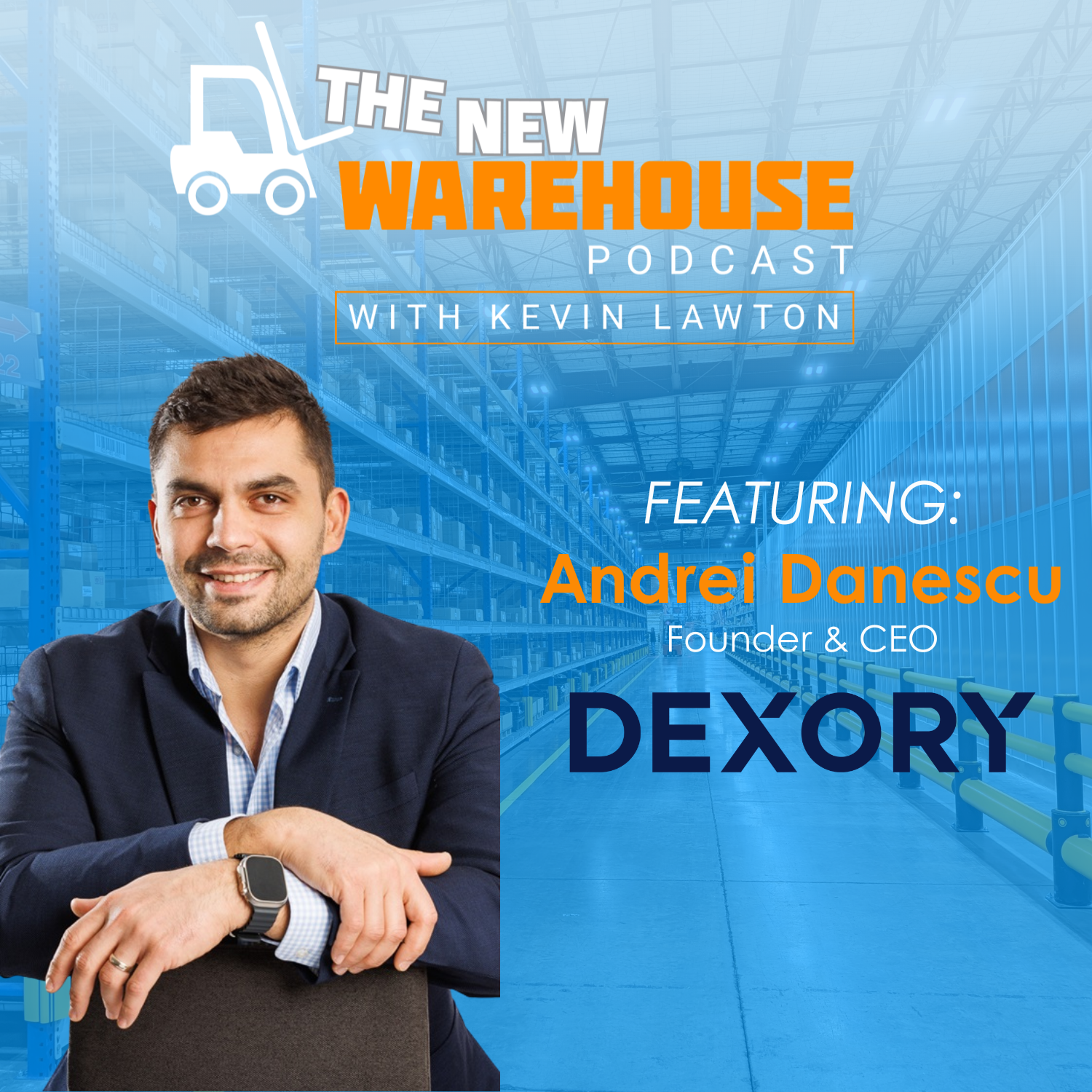
Warehouse Data as the Foundation for Operational Intelligence and AI
Welcome to this episode of The New Warehouse Podcast, where Kevin Lawton sits down with Andrei Danescu, CEO of Dexory, live from Manifest. Dexory is a data intelligence platform focused on digitizing warehouses and turning physical operations into actionable insight.
In the conversation, Andrei explains why warehouse data is the true foundation for operational intelligence. The discussion moves beyond automation headlines and into the practical work required to build a data infrastructure that actually improves warehouse performance.
Why Warehouse Data Comes First
Modern warehouse conversations often jump straight to AI. Andrei takes a step back. He frames data as the starting point rather than the outcome. “So we’re a data intelligence platform for logistics,” he explains, emphasizing that Dexory’s role begins with capturing reality, not predicting it. Without reliable data, optimization efforts stall before they start.
He points out that industrial environments cannot rely on the same assumptions as consumer AI. “You cannot apply the same mentality for industrial applications and industrial environment. It’s because the data doesn’t exist,” Andrei says. Warehouses are physical, dynamic, and often undocumented at scale—that absence of structured data limits decision-making.
Dexory addresses this gap by continuously digitizing warehouses. The goal is not visualization alone. It is operational clarity. “Creating this digital twin. And then using that data, using the insights to drive operational efficiency,” Andrei explains. Data becomes the foundation that supports informed decisions, measurable improvement, and long-term intelligence across facilities.
The World’s Tallest Autonomous Robot
Capturing warehouse data at scale has historically been slow and manual. Dexory takes a different approach. “The point around the robots is actually, it’s the most elegant way to capture the data,” Andrei says. The robots are not the product. They are the mechanism that enables continuous data capture without disruption.
These autonomous systems, such as Dexory View, scan pallet locations using cameras, lidar, and motion sensors. They operate alongside people and forklifts. In dense, high-bay environments, they can scan more than 10,000 pallet locations per hour. In some facilities, that number exceeds 20,000.
The scale matters. “We have scanned over 750 billion pallet locations so far,” Andrei notes. That dataset is growing rapidly and fuels Dexory’s digital twin platform. The result is a high-fidelity representation of warehouse reality that updates continuously. This allows operators to benchmark sites, track change over time, and identify inefficiencies that were previously invisible.
Building AI on a Real Foundation
AI is only as effective as the data beneath it. Andrei is direct about that relationship. “If you do not have the information, if it’s not grounded in reality, it’s not gonna drive the business impact that we want to see from this type of technology,” he says. In warehouses, assumptions break quickly when reality is incomplete.
Rather than positioning AI as a replacement for expertise, Andrei frames it as an accelerator. “AI is a tool, is an amplifier,” he explains. Like power tools, AI increases efficiency only when operators understand the work itself: transparency and trust matter as much as algorithms.
Dexory’s focus remains practical. AI must integrate into existing workflows and provide explainable insight. “If you have a really strong foundation, you can build infinitely large on top of it,” Andrei says. Without that foundation, AI becomes noise instead of value.
Key Takeaways
- Dexory positions warehouse data—not automation—as the starting point for operational intelligence.
- Digital twins provide a continuously updated view of warehouse reality, not static snapshots.
- Autonomous robots enable non-disruptive scanning at scale, scanning more than 10,000 pallet locations per hour.
- Dexory has scanned over 750 million pallet locations, creating one of the largest logistics datasets available.
- AI delivers value only when it is grounded in accurate, high-fidelity warehouse data.
- Operational intelligence improves when data enables benchmarking across sites and time periods.
Listen to the episode below and leave your thoughts in the comments.
Guest Information
For more information on Dexory, click here.
To connect with Andrei Danescu on LinkedIn, click here.
For more information about warehouse data, check out the podcasts below.
Warehouse Data Decision-Making Beyond Dashboards
Warehouse Continuous Improvement at Atomix: Culture and Data
Warehouse Trends October 2025: Data Integration, AI Voice, and Brownfield Breakthroughs