Smart Warehouse Technology Starts with Visibility
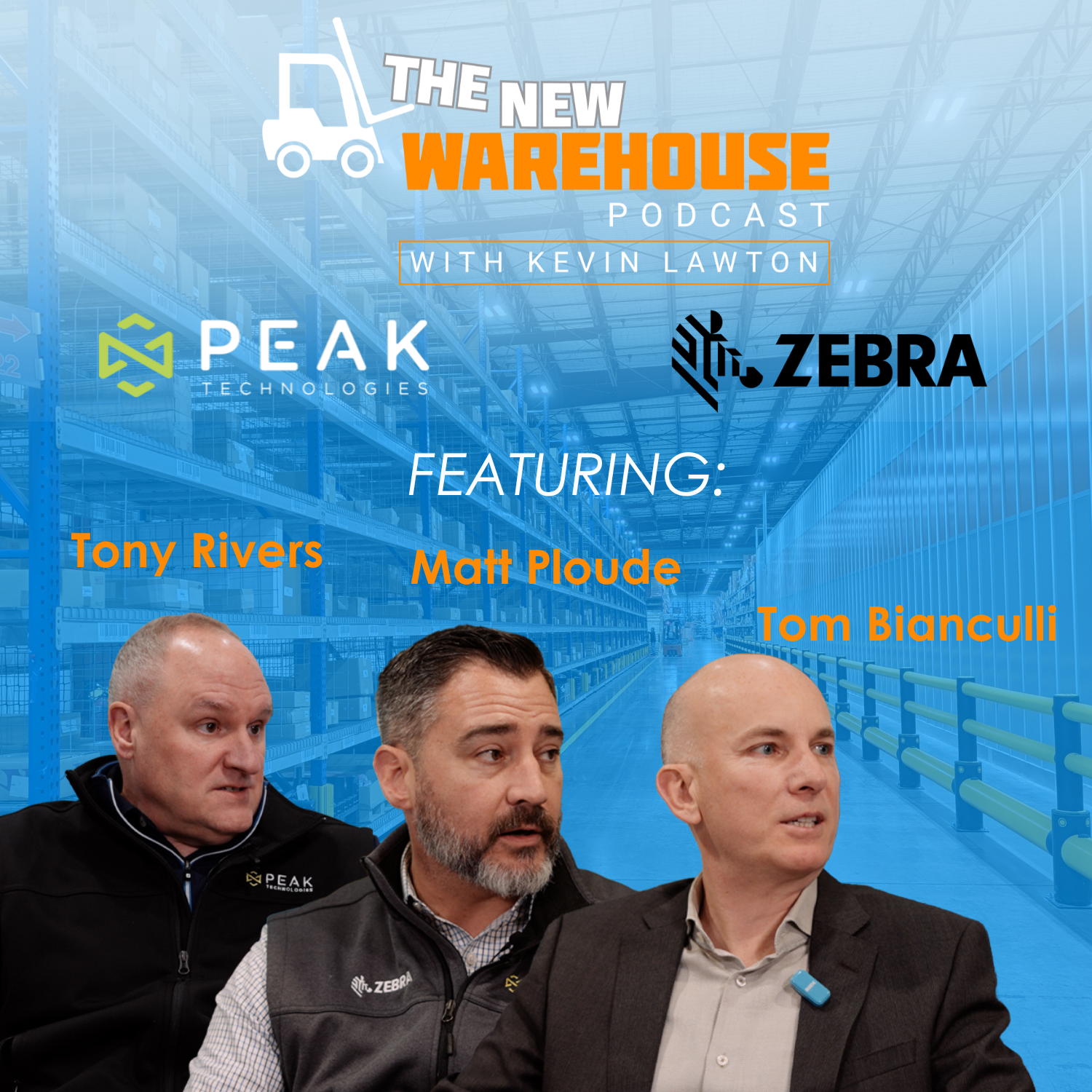
Live from the National Retail Federation Big Show in New York City, Kevin chats with Tony Rivers, CEO of Peak Technologies, Tom Bianculli, CTO of Zebra Technologies, and Matt Ploude, CTO of Peak Technologies. The conversation centers on how smart warehouse technology is reshaping operations through real-time visibility, automation, and human-centered design.
Together, Peak and Zebra explain how RFID, machine vision, and AI-driven insights are enabling both warehouses and retail stores to operate as connected fulfillment environments. Rather than chasing automation for its own sake, the discussion focuses on practical, scalable ways smart warehouse technology can improve accuracy, speed, and decision-making across the supply chain.
Real-Time Visibility as the New Operational Baseline
Visibility emerged as the foundation for every smart warehouse technology conversation at NRF. Rivers emphasized that faster decisions depend on knowing exactly where assets are at any moment, explaining that “these technologies are unlocking our ability with the combination of the additional data and movement, we can unlock things much quicker”. Instead of relying on outdated snapshots, operators now expect second-by-second insight into inventory, location, and condition.
That shift matters because fulfillment speed has changed dramatically. As Rivers noted, customer expectations have moved from days to minutes, making delayed or inaccurate data unacceptable. Ploude reinforced this by pointing to real-world impacts, explaining that without accurate, real-time data, products never reach the shelf or the customer. RFID and machine vision now provide the accuracy that warehouses expect, but stores historically lacked, closing a critical gap between planning and execution.
Machine Vision and RFID Unlock Automation Without Greenfields
Automation no longer requires starting from scratch. Ploude described smart technologies as tools that remove manual steps without disrupting existing operations, saying, “Smart technologies to me are everything that enables automation.” Machine vision and RFID capture data while goods are moving, eliminating stop-and-scan processes that slow throughput.
RFID adoption is accelerating rapidly. Bianculli shared that “the RFID is the fastest growing business at Zebra right now”, noting industry projections of more than 100 billion tags shipping annually by 2028. This scale enables item-level visibility across warehouses and stores alike. Combined with machine vision, organizations can validate contents, detect damage, and route inventory dynamically. These technologies work together, enabling automation that fits brownfield environments instead of forcing expensive rebuilds.
Intelligent Operations Still Depend on People
Despite advances in AI and automation, the discussion repeatedly returned to the human role. Bianculli framed Zebra’s approach around intelligent operations, explaining that “bringing AI, data, and automation together with human expertise to optimize workflows” is what actually drives results. Smart warehouse technology supplies insight and speed, but people still interpret, adapt, and improve processes.
Tools must empower workers, not replace them. By delivering insights directly to mobile devices, wearables, or augmented interfaces, frontline employees make faster, safer decisions. This approach also supports adoption. As Bianculli warned, skipping maturity steps or ignoring change management often causes teams to revert under pressure. Smart technology succeeds when it fits existing workflows and elevates human capability rather than fighting it.
Key Takeaways on Smart Warehouse Technology
- Real-time visibility has become essential, not optional, for modern warehouse and retail fulfillment.
- RFID adoption is accelerating, with projections exceeding 100 billion tags annually by 2028.
- Machine vision enables data capture in motion, reducing manual scans and improving throughput.
- Warehouses and stores are converging into unified fulfillment environments.
- Intelligent operations succeed when automation complements human expertise, not replaces it.
Listen to the episode below and leave your thoughts in the comments.
Guest Information
For more information on Peak Technologies, click here.
Connect with Tony Rivers on LinkedIn.
Connect with Matt Ploude on LinkedIn.
For more information on Zebra Technologies, click here.
Connect with Tom Bianculli on LinkedIn.
For more information about smart warehouse technology, check out the podcasts below.
Smart Labels for Logistics: Bringing Visibility to the Supply Chain
AI Adoption at Walmart: Putting AI in Employees’ Hands
How to Help Your Leadership Team Justify Investing in Warehouse Automation