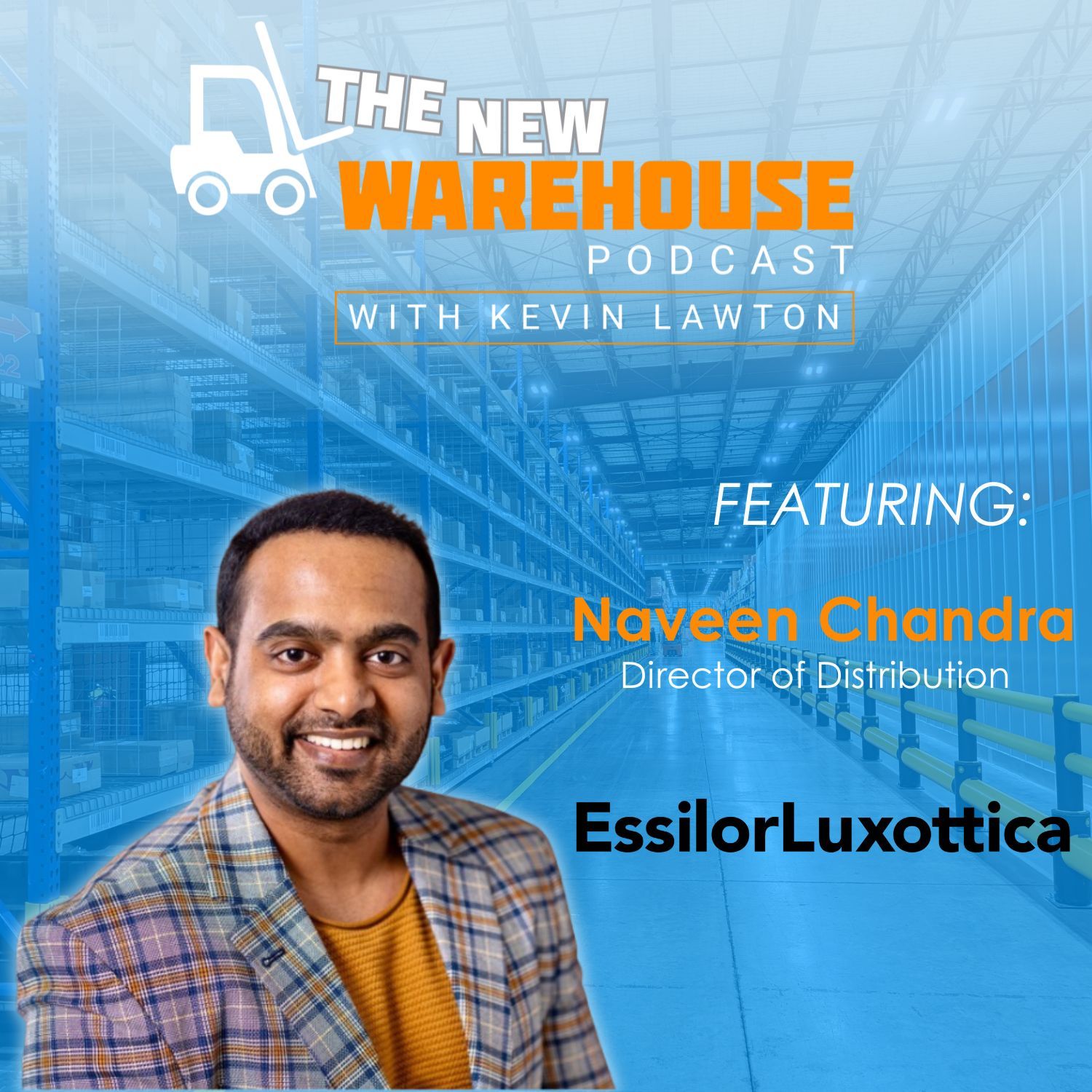
Human-Centered Warehouse Automation at EssilorLuxottica
In this episode of The New Warehouse Podcast, Kevin Lawton chats with Naveen Chandra, Director of Distribution at EssilorLuxottica. Chandra oversees strategy across labor planning, slotting, and real-time operational control for a complex, high-SKU distribution network.
EssilorLuxottica is best known for eyewear brands like Ray-Ban and Oakley, but its footprint spans eyewear, wearables, retail, and vertically integrated supply chains. The conversation explores how the company approaches automation, forecasting, and slotting while keeping human workers central to warehouse design. Rather than chasing lights-out operations, Chandra emphasizes resilience, safety, and reducing cognitive load for human-centered warehouse automation.
Designing Warehouse Automation Around People
Automation at EssilorLuxottica starts with a clear acknowledgement that warehouses remain human environments. While technology continues to advance, Chandra is direct about its current limits. “We are very far from a lights out operation today,” he explains. Machines handle routine well, but exceptions still require human judgment. When automation is designed without people in mind, risk increases rather than disappears.
Chandra shared a past ASRS example where poor inbound design created ergonomic hazards. Totes eventually weighed 40 to 50 pounds and required repeated overhead lifting. “When we create the designs, we should not ignore the human elements,” he said. “Wherever the human interacts with the system or the tool or technology, it should be safe for first and foremost priority.”
Reducing mental strain matters just as much as physical safety. Chandra stresses simplicity at the point of execution. “The cognitive load on the operator side should be as low as possible,” he notes, adding that operators should not need to stop and think through each step during high-volume workflows.
Slotting, Forecasting, and Weekly Adaptation at Scale
With thousands of SKUs and minimal dimensional variance, slotting accuracy is critical. EssilorLuxottica relies on forecasting as its foundation rather than over-engineered slotting algorithms. “AI is better suited to improve the forecast accuracy,” Chandra explains. “Once I have the forecast, slotting is just an excellent equation.”
Instead of static layouts, the slotting strategy adapts weekly. “Our slotting plan is very dynamic,” Chandra says. “We update it every week.” Fast-moving items may be upgraded to larger storage types, while slower items are downgraded to conserve space and labor.
Storage density is the first constraint Chandra evaluates. “I always start with storage space because that’s always limited,” he explains. Decisions balance the cost of relocating inventory against the efficiency of picking. Seasonal changes do not automatically trigger movement. The team weighs labor impact before re-slotting products.
This approach allows EssilorLuxottica to remain flexible without inflating labor costs or overreacting to short-term demand shifts.
Test-and-Learn Automation and the Path to Resilience
Human-centered warehouse automation investments follow a disciplined test-and-learn model. Projects start small, focusing on low-risk environments before scaling globally. “We do a small pilot, and we start small,” Chandra explains. “We place a very big emphasis on recovery plan and what’s the backup plan if the automation dies down on me.”
The company has deployed ASRS, AMRs, robotic picking, and sortation across its global footprint. Each installation contributes lessons that inform future designs. AMR-compatible racking was installed first to smooth future transitions. “What this will do is improve the inventory accuracy, and it improves the density of the product,” Chandra says.
Looking ahead, Chandra sees AI decision assistants and physical AI as the next leap. “AI decision assistant is one of the biggest things that can help distribution,” he notes. Combined with computer vision for quality control, these tools could allow warehouses to adapt in real time while keeping people firmly in control.
Key Takeaways on Human-Centered Automation
- EssilorLuxottica operates a vertically integrated, high-SKU distribution network that supports retail, wholesale, e-commerce, and emerging wearables.
- Automation strategy prioritizes human safety, ergonomics, and reduced cognitive load.
- Slotting decisions are forecast-driven and updated weekly, not locked in for the season.
- Storage density and labor impact guide slotting more than algorithmic complexity.
- Automation projects begin with small pilots and require defined recovery plans.
- AMR-ready racking enables smoother transitions without disrupting operations.
- AI decision assistants and computer vision are seen as future force multipliers.
Listen to the episode below and leave your thoughts in the comments.
Guest Information
For more information on EssilorLuxottica, click here.
To connect with Naveen Chandra on LinkedIn, click here.
For more information about human-centered warehouse automation, check out the podcasts below.
How to Help Your Leadership Team Justify Investing in Warehouse Automation