Smart Labels for Logistics: Bringing Visibility to the Supply Chain
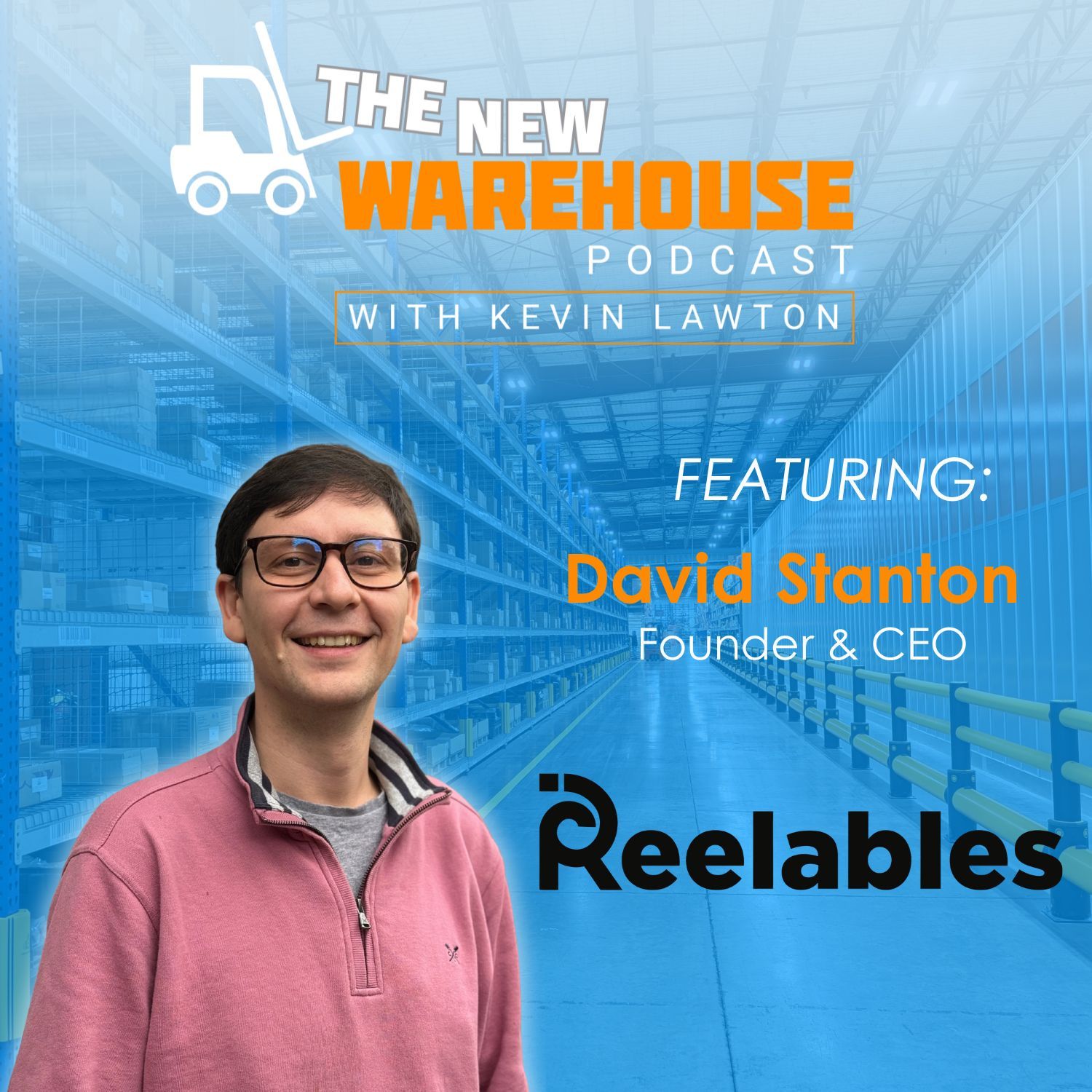
In this episode of The New Warehouse, David Stanton, CEO and Co-Founder of Reelables, explores how smart labels are changing how companies track cargo and improve supply chain visibility. Reelables develops printable, low-cost smart labels that function as active tracking devices, giving logistics teams real-time insight into where goods are, how they move, and where issues occur.
What began as an experiment in consumer tracking quickly evolved into a supply chain solution as COVID exposed visibility gaps across logistics networks. Stanton explains how smart labels now help organizations reduce loss, improve accountability, and gain clarity across warehouses, transportation networks, and global operations.
Smart Labels Bring Real-Time Visibility Inside the Warehouse
Reelables’ technology was built to solve a common problem: not knowing where things are when you need them. Their smart labels function as active Bluetooth devices, providing precise location data within facilities. As Stanton explains, “we’re able to locate one of our labels down to up to 10 centimeters of accuracy.” This level of visibility allows teams to find assets quickly, reduce search time, and eliminate delays caused by missing items.
The value becomes clear in busy environments. Stanton noted that even large manufacturers struggle with basic visibility. “The number of times that we go to a warehouse and people just need to lay eyes on a bit of cargo,” he said, explaining how teams often lose time searching for work-in-progress or tools. Smart labels help connect physical movement with digital systems, allowing warehouses to understand where items are and why delays happen.
More importantly, visibility becomes actionable. “You start to be able to look at what’s going on holistically,” Stanton explained, highlighting how location data helps identify bottlenecks, dwell time, and inefficiencies inside operations.
Why Smart Labels Outperform Traditional Tracking Methods
Smart labels differ from RFID and barcode systems in that they offer continuous visibility rather than checkpoint-based scanning. Stanton described the difference clearly: “It’s like doing a full warehouse stock check every minute.” Instead of relying on fixed readers or manual scans, smart labels transmit data automatically.
This flexibility matters in real-world operations. RFID systems often fail when assets move unpredictably or leave defined zones. As Stanton noted, “One of our Bluetooth labels, we can read it over 200 meters away, which really gives you that range. And by having that range, you get to do all sorts of different things. And then cellular technologies totally remove the need for any infrastructure, so that’s when you can start to track outside of your facilities.” Smart labels solve this by working across warehouses, yards, and transportation networks.
Cost has historically been a barrier to tracking, but that is changing rapidly. “Today, something like 0.001% of cargo and inventory is actively tracked,” Stanton said, mainly due to cost. That gap is closing fast. He explained that tracking once cost over $100 per unit, but “we retail our cellular label for about $25, and that will drop below $10.” This shift makes large-scale tracking financially viable for the first time.
Reducing Loss, Theft, and Supply Chain Blind Spots
One of the most compelling use cases for smart labels is loss prevention. Stanton shared a real-world example where a shipment showed “delivered” for months but never arrived. “The value of the parcel was inconsequential, not being able to do work because it was missing is a big deal,” he said. Visibility revealed the package had been diverted to a facility handling undeliverable freight.
That same capability helps companies detect theft and diversion. “We have customers that want to look at diversion within their supply chain,” Stanton explained, referencing cases where goods intended for one market appeared in another. Smart labels allow companies to track movement patterns and identify when products go where they shouldn’t.
The technology also supports theft prevention inside warehouses. “We’re checking every two minutes to see if anything split from that shipment,” Stanton said. This allows companies to detect when items are unexpectedly removed from pallets or shipments, helping reduce loss and improve accountability.
Key Takeaways
- Smart labels provide real-time supply chain visibility without heavy infrastructure.
- Reelables’ labels can track items with 10-centimeter accuracy.
- Bluetooth and cellular tracking enable visibility across warehouses and transit.
- Active tracking reduces loss, theft, and misplaced inventory.
- Costs have dropped dramatically, making large-scale tracking feasible.
- Smart labels help identify bottlenecks, dwell time, and process inefficiencies.
- Visibility enables faster response when shipments go missing.
Listen to the episode below and leave your thoughts in the comments.
Guest Information
For more information on Reelables, click here.
To connect with David Stanton on LinkedIn, click here.
For more information about smart label tracking, check out the podcasts below.
Smart Warehouse Technologies Driving Real-Time Operations
Exploring Smart Warehouse Technologies with Peak Technologies – RFID, Machine Vision and Barcodes
In this episode of The New Warehouse, David Stanton, CEO and Co-Founder of Reelables, explores how smart labels are changing how companies track cargo and improve supply chain visibility. Reelables develops printable, low-cost smart labels that function as active tracking devices, giving logistics teams real-time insight into where goods are, how they move, and where issues occur.
What began as an experiment in consumer tracking quickly evolved into a supply chain solution as COVID exposed visibility gaps across logistics networks. Stanton explains how smart labels now help organizations reduce loss, improve accountability, and gain clarity across warehouses, transportation networks, and global operations.
Smart Labels Bring Real-Time Visibility Inside the Warehouse
Reelables’ technology was built to solve a common problem: not knowing where things are when you need them. Their smart labels function as active Bluetooth devices, providing precise location data within facilities. As Stanton explains, “we’re able to locate one of our labels down to up to 10 centimeters of accuracy.” This level of visibility allows teams to find assets quickly, reduce search time, and eliminate delays caused by missing items.
The value becomes clear in busy environments. Stanton noted that even large manufacturers struggle with basic visibility. “The number of times that we go to a warehouse and people just need to lay eyes on a bit of cargo,” he said, explaining how teams often lose time searching for work-in-progress or tools. Smart labels help connect physical movement with digital systems, allowing warehouses to understand where items are and why delays happen.
More importantly, visibility becomes actionable. “You start to be able to look at what’s going on holistically,” Stanton explained, highlighting how location data helps identify bottlenecks, dwell time, and inefficiencies inside operations.
Why Smart Labels Outperform Traditional Tracking Methods
Smart labels differ from RFID and barcode systems in that they offer continuous visibility rather than checkpoint-based scanning. Stanton described the difference clearly: “It’s like doing a full warehouse stock check every minute.” Instead of relying on fixed readers or manual scans, smart labels transmit data automatically.
This flexibility matters in real-world operations. RFID systems often fail when assets move unpredictably or leave defined zones. As Stanton noted, “One of our Bluetooth labels, we can read it over 200 meters away, which really gives you that range. And by having that range, you get to do all sorts of different things. And then cellular technologies totally remove the need for any infrastructure, so that’s when you can start to track outside of your facilities.” Smart labels solve this by working across warehouses, yards, and transportation networks.
Cost has historically been a barrier to tracking, but that is changing rapidly. “Today, something like 0.001% of cargo and inventory is actively tracked,” Stanton said, mainly due to cost. That gap is closing fast. He explained that tracking once cost over $100 per unit, but “we retail our cellular label for about $25, and that will drop below $10.” This shift makes large-scale tracking financially viable for the first time.
Reducing Loss, Theft, and Supply Chain Blind Spots
One of the most compelling use cases for smart labels is loss prevention. Stanton shared a real-world example where a shipment showed “delivered” for months but never arrived. “The value of the parcel was inconsequential, not being able to do work because it was missing is a big deal,” he said. Visibility revealed the package had been diverted to a facility handling undeliverable freight.
That same capability helps companies detect theft and diversion. “We have customers that want to look at diversion within their supply chain,” Stanton explained, referencing cases where goods intended for one market appeared in another. Smart labels allow companies to track movement patterns and identify when products go where they shouldn’t.
The technology also supports theft prevention inside warehouses. “We’re checking every two minutes to see if anything split from that shipment,” Stanton said. This allows companies to detect when items are unexpectedly removed from pallets or shipments, helping reduce loss and improve accountability.
Key Takeaways
- Smart labels provide real-time supply chain visibility without heavy infrastructure.
- Reelables’ labels can track items with 10-centimeter accuracy.
- Bluetooth and cellular tracking enable visibility across warehouses and transit.
- Active tracking reduces loss, theft, and misplaced inventory.
- Costs have dropped dramatically, making large-scale tracking feasible.
- Smart labels help identify bottlenecks, dwell time, and process inefficiencies.
- Visibility enables faster response when shipments go missing.
Listen to the episode below and leave your thoughts in the comments.
Guest Information
For more information on Reelables, click here.
To connect with David Stanton on LinkedIn, click here.
For more information about smart label tracking, check out the podcasts below.
Smart Warehouse Technologies Driving Real-Time Operations
Exploring Smart Warehouse Technologies with Peak Technologies – RFID, Machine Vision and Barcodes
In this episode of The New Warehouse, David Stanton, CEO and Co-Founder of Reelables, explores how smart labels are changing how companies track cargo and improve supply chain visibility. Reelables develops printable, low-cost smart labels that function as active tracking devices, giving logistics teams real-time insight into where goods are, how they move, and where issues occur.
What began as an experiment in consumer tracking quickly evolved into a supply chain solution as COVID exposed visibility gaps across logistics networks. Stanton explains how smart labels now help organizations reduce loss, improve accountability, and gain clarity across warehouses, transportation networks, and global operations.
Smart Labels Bring Real-Time Visibility Inside the Warehouse
Reelables’ technology was built to solve a common problem: not knowing where things are when you need them. Their smart labels function as active Bluetooth devices, providing precise location data within facilities. As Stanton explains, “we’re able to locate one of our labels down to up to 10 centimeters of accuracy.” This level of visibility allows teams to find assets quickly, reduce search time, and eliminate delays caused by missing items.
The value becomes clear in busy environments. Stanton noted that even large manufacturers struggle with basic visibility. “The number of times that we go to a warehouse and people just need to lay eyes on a bit of cargo,” he said, explaining how teams often lose time searching for work-in-progress or tools. Smart labels help connect physical movement with digital systems, allowing warehouses to understand where items are and why delays happen.
More importantly, visibility becomes actionable. “You start to be able to look at what’s going on holistically,” Stanton explained, highlighting how location data helps identify bottlenecks, dwell time, and inefficiencies inside operations.
Why Smart Labels Outperform Traditional Tracking Methods
Smart labels differ from RFID and barcode systems in that they offer continuous visibility rather than checkpoint-based scanning. Stanton described the difference clearly: “It’s like doing a full warehouse stock check every minute.” Instead of relying on fixed readers or manual scans, smart labels transmit data automatically.
This flexibility matters in real-world operations. RFID systems often fail when assets move unpredictably or leave defined zones. As Stanton noted, “One of our Bluetooth labels, we can read it over 200 meters away, which really gives you that range. And by having that range, you get to do all sorts of different things. And then cellular technologies totally remove the need for any infrastructure, so that’s when you can start to track outside of your facilities.” Smart labels solve this by working across warehouses, yards, and transportation networks.
Cost has historically been a barrier to tracking, but that is changing rapidly. “Today, something like 0.001% of cargo and inventory is actively tracked,” Stanton said, mainly due to cost. That gap is closing fast. He explained that tracking once cost over $100 per unit, but “we retail our cellular label for about $25, and that will drop below $10.” This shift makes large-scale tracking financially viable for the first time.
Reducing Loss, Theft, and Supply Chain Blind Spots
One of the most compelling use cases for smart labels is loss prevention. Stanton shared a real-world example where a shipment showed “delivered” for months but never arrived. “The value of the parcel was inconsequential, not being able to do work because it was missing is a big deal,” he said. Visibility revealed the package had been diverted to a facility handling undeliverable freight.
That same capability helps companies detect theft and diversion. “We have customers that want to look at diversion within their supply chain,” Stanton explained, referencing cases where goods intended for one market appeared in another. Smart labels allow companies to track movement patterns and identify when products go where they shouldn’t.
The technology also supports theft prevention inside warehouses. “We’re checking every two minutes to see if anything split from that shipment,” Stanton said. This allows companies to detect when items are unexpectedly removed from pallets or shipments, helping reduce loss and improve accountability.
Key Takeaways
- Smart labels provide real-time supply chain visibility without heavy infrastructure.
- Reelables’ labels can track items with 10-centimeter accuracy.
- Bluetooth and cellular tracking enable visibility across warehouses and transit.
- Active tracking reduces loss, theft, and misplaced inventory.
- Costs have dropped dramatically, making large-scale tracking feasible.
- Smart labels help identify bottlenecks, dwell time, and process inefficiencies.
- Visibility enables faster response when shipments go missing.
Listen to the episode below and leave your thoughts in the comments.
Guest Information
For more information on Reelables, click here.
To connect with David Stanton on LinkedIn, click here.
For more information about smart label tracking, check out the podcasts below.
Smart Warehouse Technologies Driving Real-Time Operations
Exploring Smart Warehouse Technologies with Peak Technologies – RFID, Machine Vision and Barcodes