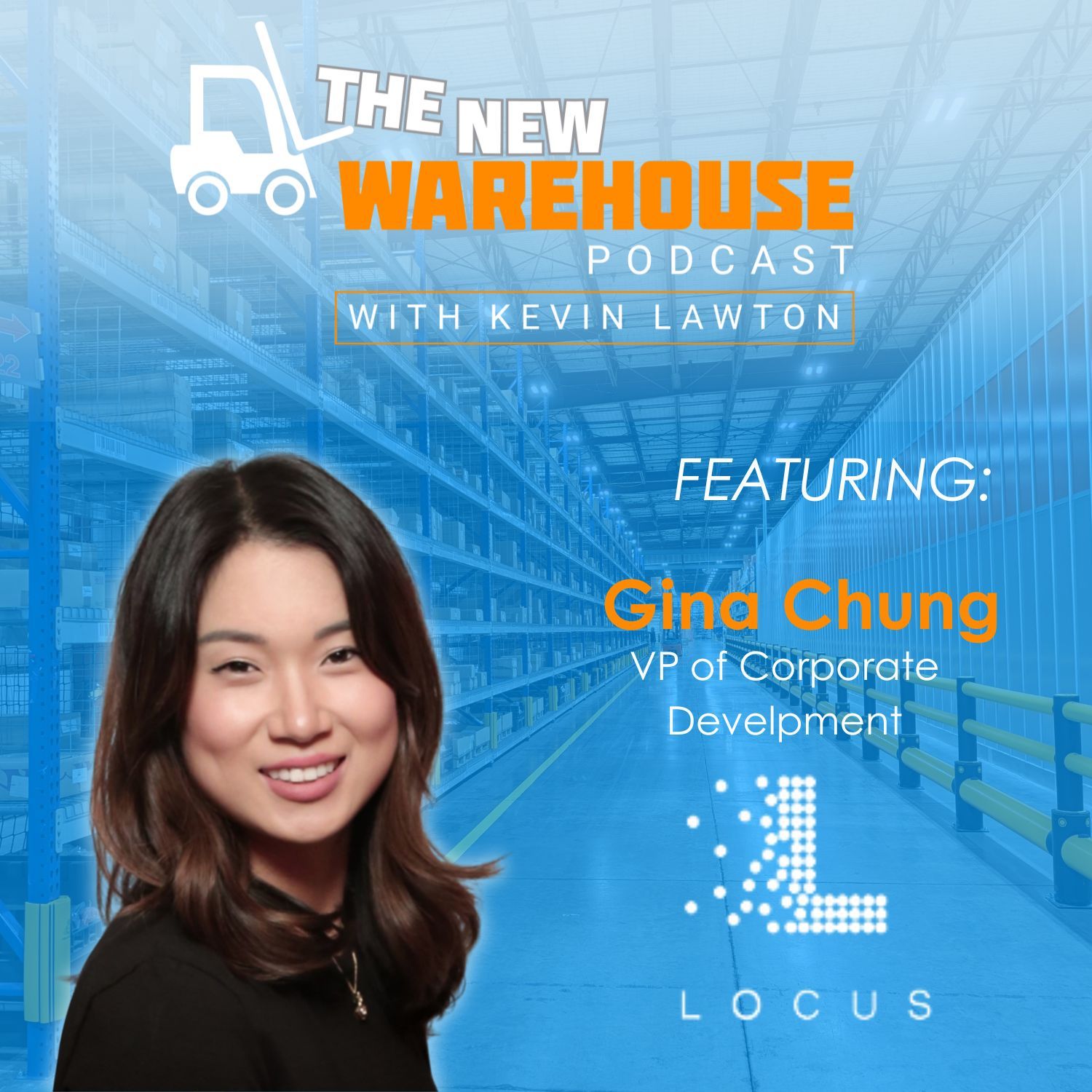
Flexible Warehouse Automation and the Future of Fulfillment
In this episode of The New Warehouse Podcast, Kevin Lawton welcomes Gina Chung, Vice President of Corporate Development at Locus Robotics, for a wide-ranging conversation on how warehouse automation is evolving and why flexibility has become a defining requirement for modern fulfillment operations. With more than a decade of experience leading innovation initiatives at DHL before joining Locus, Chung brings a unique perspective shaped by firsthand exposure to large-scale warehouse environments.
The discussion explores how automation adoption has matured, why rigid systems no longer fit today’s supply chains, and how Locus is approaching the next phase of robotic fulfillment as the industry looks toward 2026 and beyond.
Why Flexible Warehouse Automation Has Become Essential
Chung notes that the pace of change and disruptions in global supply chains make flexible warehouse automation essential, not optional. “I think one of the big lessons coming out of all of those different disruptions was the need for flexibility in your operations so that you can respond to changes in volume, changes in skew profiles.”
Chung explains that early hesitation over the past decade about automation stemmed from uncertainty about reliability and scalability, especially when robotics were still unproven in real-world environments. Robotics vendors were new, the technology wasn’t proven at scale, and reliability in real-world environments was still an open question. “Flexible automation is like a rocket ship taking off in the next few years,” adds Chung. “I think it’s because operators realize the value of flexibility in their operation in an uncertain world.” Today, warehouse leaders are no longer asking whether to automate, but how to do so in a way that allows them to adapt quickly as conditions change.
How Locus Array Advances Robot-to-Goods Fulfillment
The growing need for flexible warehouse automation is what led to the development of Locus Array. Chung explains that the goal was to give operators more choice and flexibility, noting that “we started development of Locus Array, roughly around three years ago, to really add to what we call full spectrum automation.” As she describes it, “customers of Locus… integrate to our platform and now they can pick and mix between various kinds of robots to handle different workflows,” including both person-to-goods and fully automated approaches.
For years, the idea of a lights-out warehouse felt more aspirational than achievable. Chung acknowledges that reality, saying, “There’s always been this kind of holy grail discussion… what if you had this kind of lights-out warehouse?” Now, she believes the technology has finally reached that point. “We believe that now is the right time to bring that kind of holy grail idea to life.” For many operators, the appeal lies in automating more of their operations while still maintaining the flexibility Locus is known for.
Why Purpose-Built Robotics Outperform Humanoids
Rather than moving toward fully lights-out facilities overnight, Chung sees the future as a hybrid model. Automation will continue to expand, but human workers will remain essential for oversight, exception handling, and system optimization. As interest in humanoid robots grows, she offers a pragmatic view of their role in warehouse operations, explaining that “Humanoids are a general-purpose solution designed to handle all sorts of different tasks across different industries,” she explains. “I just think if you are trying to solve the problem, it’s going to be a special-purpose solution that wins.”
The distinction, she notes, comes down to warehouse efficiency and practicality. Successful fulfillment environments require speed, density, and repetition, which makes specialized robotics better suited for the job. Locus Array was built with those realities in mind, focusing on high-throughput workflows rather than mimicking human movement. As Chung explains, “How do you make fulfillment as efficient as possible, lower cost per pick, and all of that good stuff? It’s going to be special-purpose solutions that win.”
Key Takeaways
- Flexible warehouse automation has become a necessity, not a luxury.
- Locus supports over 16,000 robots across more than 350 sites.
- The company has surpassed 6 billion robotic picks.
- Locus Array enables robot-to-goods fulfillment without significant infrastructure changes.
- Purpose-built robotics outperform humanoids in fulfillment environments.
- The future warehouse will blend automation with human oversight rather than eliminate labor entirely.
Listen to the episode below and leave your thoughts in the comments.
Guest Information
For more information on Locus Robotics, click here.
To connect with Gina Chung on LinkedIn, click here.
For more information about flexible warehouse automation, check out the podcasts below.
630: Building Flexible Automation Solutions with Daifuku
631: Customer-Centric Automation with Adrian Stoch of Hai Robotics